.png)

Usually, yes. A DSCR loan prepayment penalty is a fee for paying off the loan early, typically 1% to 5% of the outstanding balance during the first five years or fewer. The most common structure is a descending 5/4/3/2/1 (5% in year one, falling to 1% in year five), and 3/2/1, flat and “California-style” options also exist. In exchange for accepting a penalty, borrowers generally get a lower rate or fewer points.
State law matters. Most states allow prepayment penalties on DSCR loans, some restrict them and a few, like Alaska and New Mexico, don’t allow them. Ohio and Pennsylvania, for example, limit or prohibit penalties on 1–2 unit loans below inflation-adjusted thresholds ($116,356 in Ohio and $329,411 in Pennsylvania for 2026).
Once you have a solid understanding of the basics of DSCR Loans structure, savvy borrowers can really optimize their financing by further customizing their loans with more advanced provisions. These loan aspects, particularly prepayment penalty provisions and hybrid (fixed to ARM) rate structures are more complex, however a thorough understanding of how they work and when to utilize them can mean the difference between okay returns and the type of snowballing wealth that is the key to achieving financial freedom.
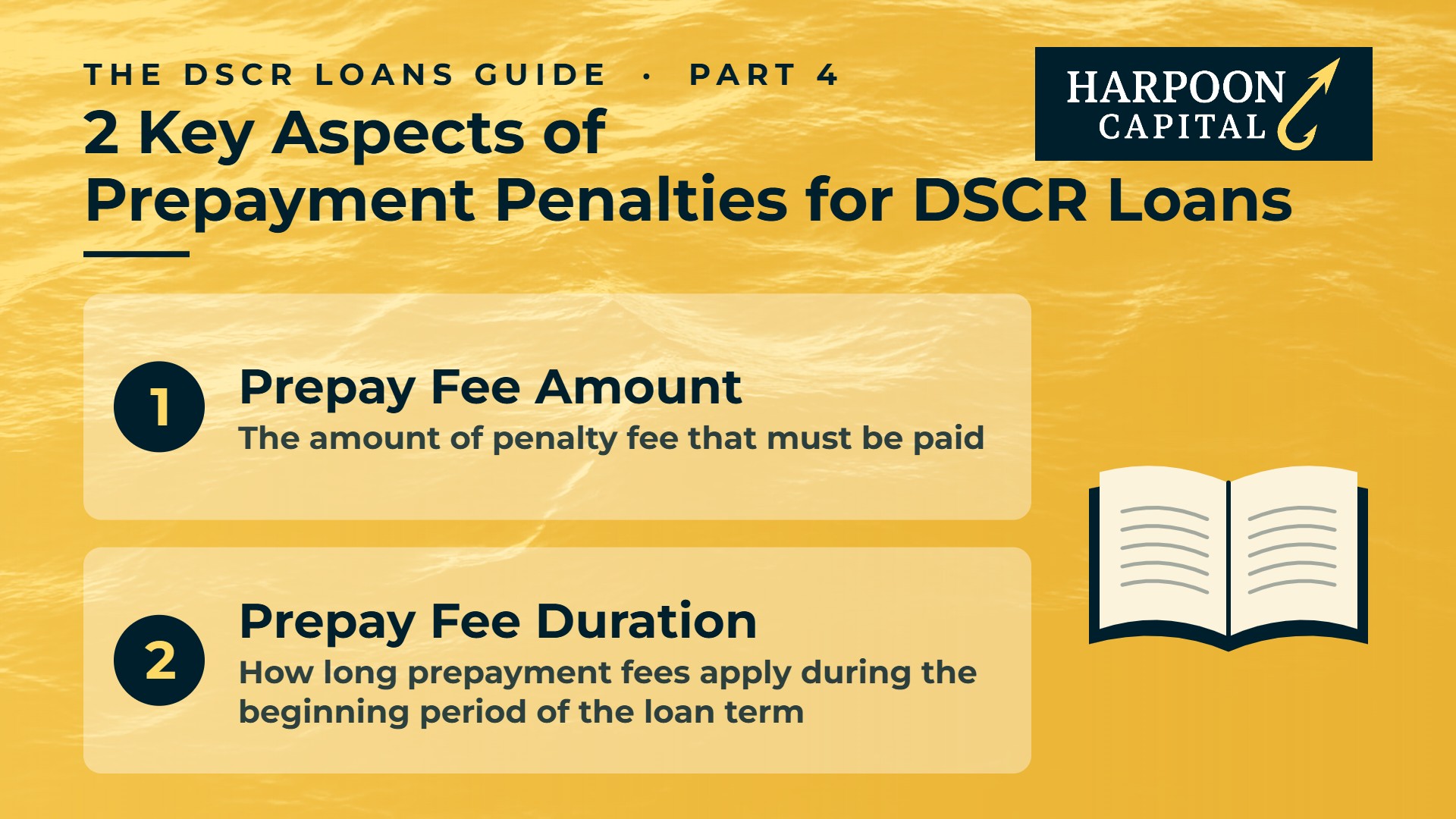
Prepayment penalties are a key provision in DSCR Loans that determine if there are any fees associated with paying the loan off prior to its maturity date. Prepayment Penalty Provisions for DSCR Loans have two key aspects:
1) Prepay Fee Amount which means that amount of the penalty fee that must be paid by the borrower (typically expressed as a percentage of the outstanding loan balance) and
2) Prepay Fee Duration (or how long the prepayment fee applies, typically expressed in years, but better expressed and thought of in months or payment dates). While prepayment penalties represent an additional cost to the borrower, they can actually be advantageous for some investors since harsher (higher fee percentages and/or longer penalty periods) prepayment provisions allow lenders to offer significantly lower rates and better terms. This is because it allows DSCR lenders and note holders to protect their own cash flows in case market interest rates fall and borrowers refinance into lower rates. In this case, the lenders can protect their investment by knowing less refinancing activity will occur in the future or if interest rates decline, they will still obtain expected returns through collection of a prepayment penalty fee.
For DSCR Loans, prepayment penalty provisions are not nearly as restrictive as similar prepayment provisions found in other types of financing such as commercial real estate loans (“CRE”) that are also turned into securitized bonds (Commercial Mortgage Backed Securities or “CMBS”). For DSCR Loans, there aren’t ever any lockout periods (or portions of the loan term where prepayment isn’t even allowed at all – not even with a penalty) and the fees are typically both much lower and in place for a much shorter period of time at the beginning of the term than CRE loans. Thus, DSCR Loan borrowers can utilize prepayment penalty provisions that don’t have nearly as much bite as with other loan products, but also achieve the benefits of significantly lower rates and better terms.
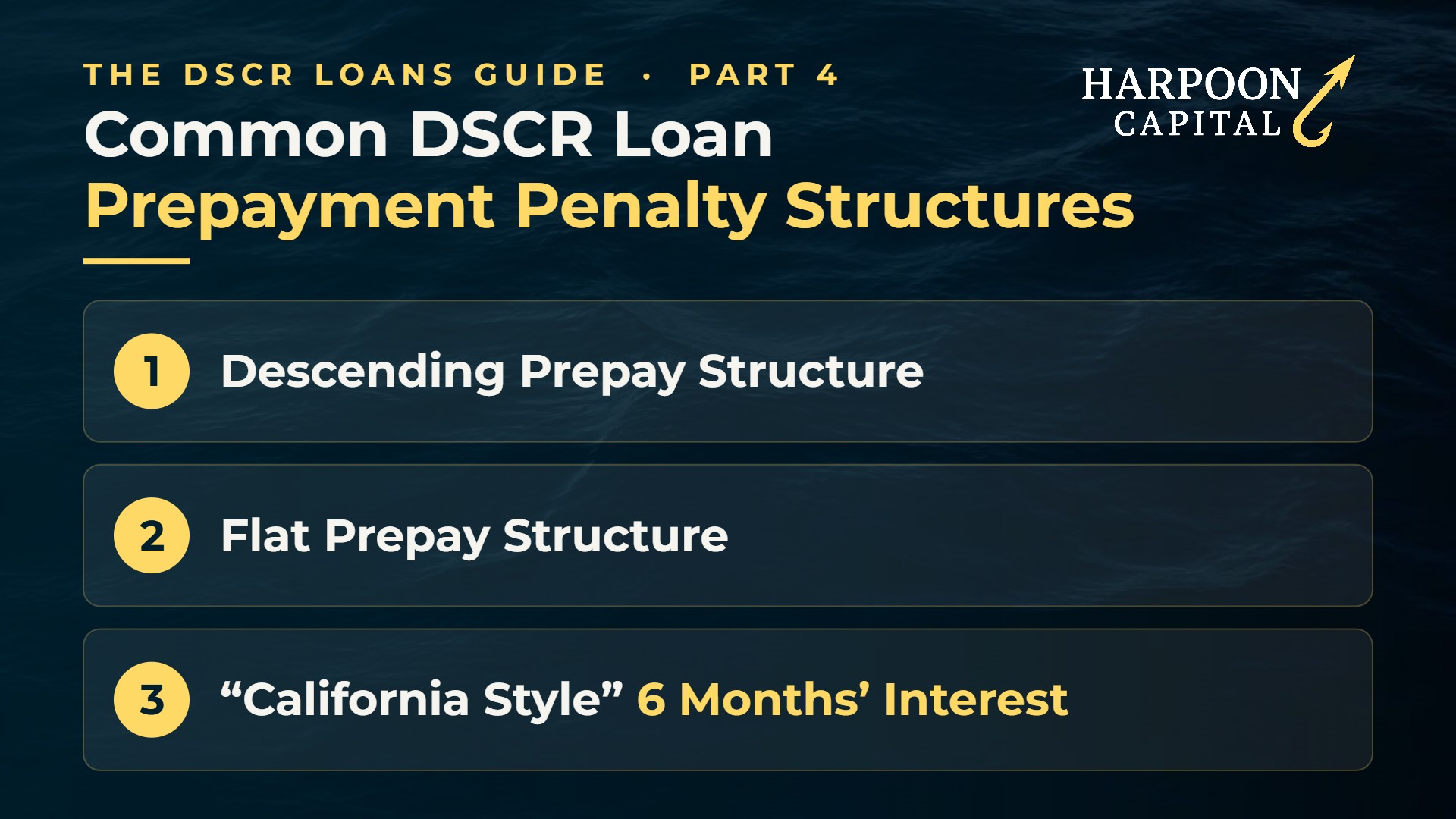
The Prepayment Penalty Fee Amount for DSCR Loans typically range from 1% to 5% of the outstanding loan balance. There may be some rare instances of lenders offering higher fees than this, but in the vast majority of the time, the fees will be in this range. The most common DSCR Loan prepayment structure is what’s typically called a “Descending Prepay” which means that the fee starts out at a numeric percentage and then over the course of the loan term and prepayment penalty period the penalty percentage decreases (or “descends”). A typical prepayment structure is commonly called “5/4/3/2/1” which means that for a 30-year DSCR loan, there is a 5% fee if prepaid in the first year, 4% if prepaid in the second year, 3% if prepaid in the third year, 2% if prepaid in the fourth year, 1% if prepaid in the fifth year, and no fees due at all for the last 25 years of the term. While the most common is this “5/4/3/2/1” structure, many lenders offer customization within this structure, with “3/2/1” (only three years instead of five and starting with 3% penalties) or “2/1” often available. Note that some states, like Mississippi, allow only descending prepayment structures like this for DSCR Loans (more on state-by-state prepayment nuance below).
Prepayment penalty fees can also be a “Flat Prepay” fee – where instead of descending, the fee remains the same for the entire duration of the penalty period. For a structure like this, such as a “5/5/5/5/5” prepayment, this means it’s a 5% fee assessed on the outstanding loan balance for the full five year period, then no penalty applies. The Prepayment Penalty Period simply refers to the length of time the penalty period is in effect at the beginning of the loan term. The vast majority of DSCR Loans with prepayment penalty provisions will have penalty periods in effect for five years or fewer, with rare cases stretched to six or seven years. The combination of fee amount and penalty period duration determines how much benefit (lower rate or fewer points) a borrower receives in exchange.
Besides the descending and flat prepayment structures, a third somewhat common DSCR loan prepayment structure is also sometimes available, especially in California and western states (indeed, its often referred to as “California-Style” Prepay”). This structure typically entails a fee amount of six months’ worth of interest payments (or calculated as interest rate divided by two), often for the first five years of the term. However, what is key and not always understood is that this provision only applies to prepayment in excess of 20% of the principal balance each year. This is a key difference between this prepayment structure and the more common “Descending Prepay” or “Flat Prepay” structures that apply the full penalty amount to any amount prepaid, with no fee-free prepayments of up to 20% of the loan balance each year in the prepayment period. This “20% freely prepayable” provision can save significant amounts for some borrowers as the fee applies to only 80% of the balance instead of the full 100% in other structures. Further, it can be a great option for investors that choose to do partial prepayments as there will be no prepayment penalty fee at all if only 20% is prepaid each year for five years!
One of the biggest sources of confusion with DSCR Loans is running into restrictions on prepayment penalties based on the state in which the mortgaged property is located. While most DSCR Lenders will have standard prepayment options available as general default options (i.e. “5/4/3/2/1” or “3/2/1”), there are some states where prepayment penalties for DSCR Loans are not allowed, or restricted in fee, length and structure.
While this would be an unfortunate headache to worry about in and of itself, what makes things worse is that the state laws and regulations that determine these restrictions are often vague and interpreted differently from lender to lender. As of 2026, there are many states where, regrettably, there isn’t a legal consensus on whether prepayment penalties are allowed, restricted or banned outright. This includes large states with lots of DSCR Loan volume including Pennsylvania and Michigan. Experienced DSCR borrowers with geographically diverse portfolios have likely run into situations in which different DSCR lenders provided materially different quotes or options based on their interpretations, and these lender policies and interpretations, which frequently change, can confuse even the most experienced and up-to-date mortgage broker or loan officer. These negative “surprises,” especially if occurring in the middle of a live deal process can cause serious heartburn among borrowers and everyone involved in the effort to close loans successfully and quickly.

Why do restrictions on offering prepayment penalties for DSCR Loans exist in some states? Ultimately, these restrictions stem from well-meaning regulations on residential mortgage loan borrowers from signing up for significant debt obligations without understanding hefty fees and complex provisions. However, the intent and purpose of many of these regulations were for everyday borrowers typically taking on owner-occupied home loans, not real estate investors using loans for the business purpose of generating cash flow from income-producing rental properties. This original intent makes sense: For example, a married couple that consists of an engineer and teacher, might make a couple of home purchases in their entire lives, and shouldn’t be expected to understand or fully comprehend the nuanced nature of fees and penalty provisions. Additionally, if an unsophisticated borrower misunderstands the prepayment penalty provisions of their documents and ends up defaulting, then they could be out on the street and potentially homeless, an outcome nobody likes to see and the states should arguably enact regulations and rules to protect against. Like most regulations now governing mortgage lending in the United States, rules around prepayment penalty provisions stem from lessons learned from the 2008 financial crisis.
However, restrictions on prepayment penalties through state-level regulations don’t make nearly as much sense for DSCR Loans. Since these properties are strictly utilized for a business purpose, and the borrowers are choosing to invest in real estate as a business and income-generating activity, a much higher level of sophistication should be assumed as compared to an average homeowner that isn’t in the business of real estate investing. Additionally, a foreclosure of a rental property would almost always have much less severe consequences as losing an owner-occupied home; one involves potential homelessness, the other, while not ideal, generally means a loss of an income stream and some savings.
In this context, it should make a lot of sense in that there are rules against prepayment penalty provisions for government-sponsored conventional mortgage loans, but for DSCR Loans provided by private lenders strictly to investors, the choice by the individual DSCR Loan borrower to choose the length and structure of their prepayment penalty, and enjoy the commensurate lower interest rates and fees, should exist. Pretty much every DSCR Lender will always allow an option with no prepayment penalties too (just with much higher fees and rate). As of 2026, it remains an unfortunate aspect of DSCR Loans, for both borrowers and lenders alike, as many state statutes that likely have been written to protect homeowners, continue to be stubbornly applied to business-purpose DSCR Loans for rental properties in some cases, even though it’s likely that’s not the true intent, and these interpretations cause more harm than help.
Despite the likely unforeseen negative consequences of some laws and regulations regarding prepayment, it is a reality of DSCR Loans right now. The best thing to do as a real estate investor and well-informed borrower is to stay up to date and ask your mortgage broker or loan officer early and often what their specific policies are on prepayment penalties in the state or states you are investing in. It always makes sense to double check and keep these in mind when underwriting your deals and even when in the early stages of exploring new markets and real estate investing opportunities. As a helpful resource, please see below for an overview and understanding of general interpretations across the DSCR Loan industry of state-by-state policies on prepayment penalties.
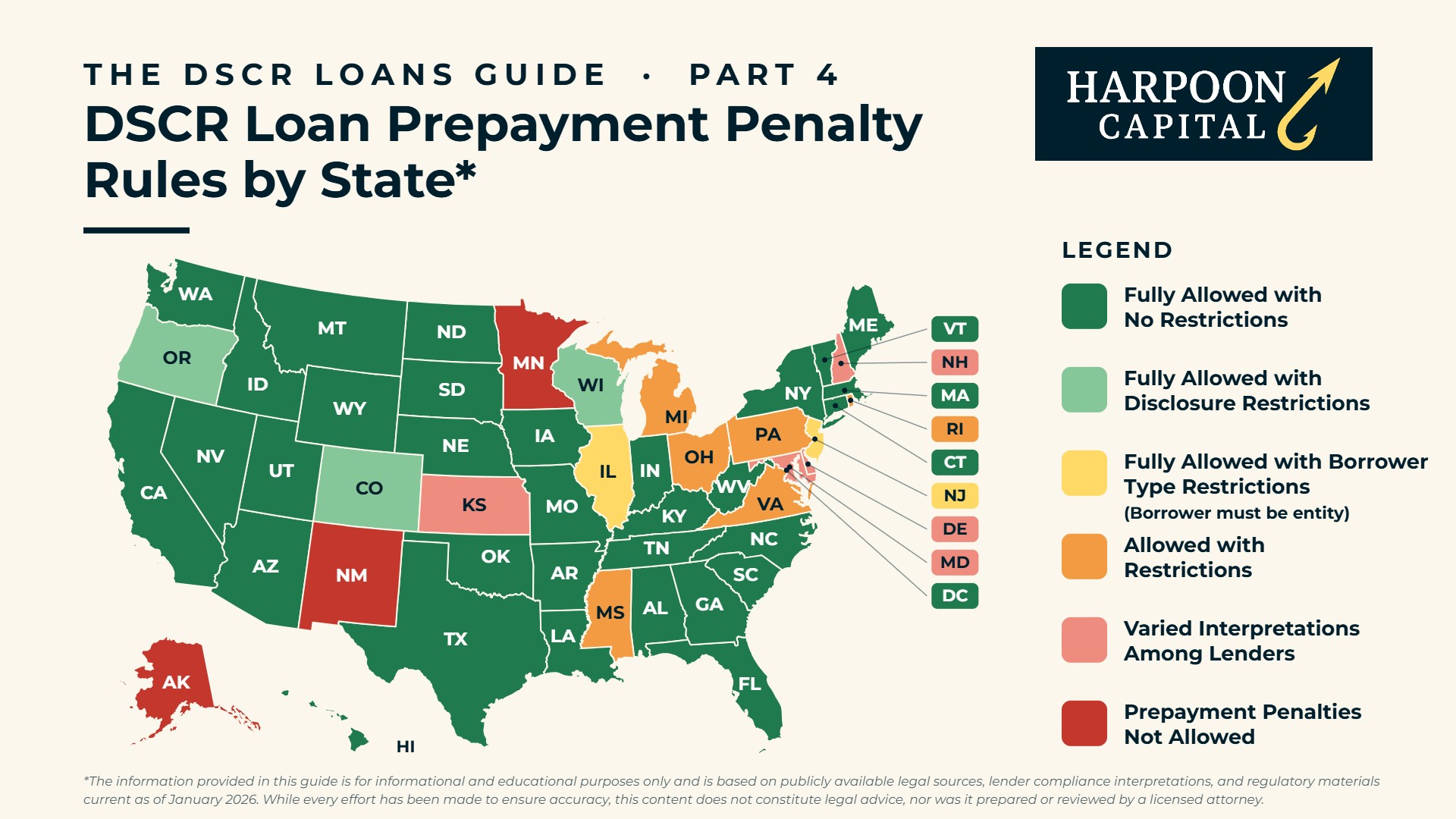
Note that the following state level summaries provide an overview of standard DSCR loans secured by one-to-four-unit properties, and DSCR Loans secured by multifamily (5+ units), mixed used (include 1-3 commercial units) or portfolios (three or more individual properties, also referred to as “cross-collateralized”), generally are interpreted to have no statutory or lender restrictions on prepayment penalties.

Prepayment Penalties are Fully Allowed with no restrictions for DSCR Loans in Alabama. Alabama law limits prepayment penalties only on consumer credit transactions, not business-purpose loans. The state caps prepayment penalties on consumer credit at $100 under §5-19-4 — but this applies only to debt for personal, family, or household use. Since DSCR Loans are strictly utilized for business purposes, not consumer use, DSCR Lenders can typically offer all standard prepayment penalty options such as Descending Prepay Penalties (i.e. “3/2/1”), Flat Prepay (i.e. 5/5/5/5/5) or other tailored structures in the Yellowhammer State.
Interested in a DSCR Loan in Alabama? Check out our Alabama DSCR Loans page with market insights, a live DSCR calculator and more →

Prepayment Penalties are Not Allowed on DSCR Loans in Alaska. Alaska Statutes § 45.45.010(g) explicitly states that loans secured by one-to-four family dwellings may be prepaid without a prepayment penalty, unless the loan is federally insured. Since DSCR Loans are not federally backed and there is no specific distinction between owner or tenant occupancy for one-to-four-unit properties, DSCR Lenders cannot offer prepayment penalty options in Alaska, except potentially for multifamily (5+ unit) or mixed-use properties.
Interested in a DSCR Loan in Alaska? Check out our Alaska DSCR Loans page with market insights, a live DSCR calculator and more →

Prepayment Penalties are Fully Allowed with no restrictions for DSCR Loans in Arizona. Arizona state law allows prepayment penalties on loans that are not made for personal, family, or household purposes. Since DSCR Loans are strictly utilized for business purposes, not consumer use, DSCR Lenders can typically offer all standard prepayment penalty options such as Descending Prepay Penalties (i.e. “5/4/3/2/1”), Flat Prepay (i.e. 4/4/4/4) or other tailored structures in the Grand Canyon State.

Prepayment Penalties are Fully Allowed with no restrictions for DSCR Loans in Arkansas. Arkansas law allows prepayment penalties on loans made by “exempt entities”, which is universally interpreted to include DSCR Lenders, under § 23-39-502(9)(B)(vi). While § 23-39-513 limits prepayment penalties to three years for some licensed lenders, those rules do not apply to exempt institutions, which include banks, credit unions, and certain mortgage companies. As such, DSCR Lenders can typically offer all standard prepayment penalty options such as Descending Prepay Penalties (i.e. “5/4/3/2/1”), Flat Prepay (i.e. 5/5/5) or other tailored structures in the Natural State.
Interested in a DSCR Loan in Arkansas? Check out our Arkansas DSCR Loans page with market insights, a live DSCR calculator and more →

Prepayment Penalties are Fully Allowed with no restrictions for DSCR Loans in California. California law permits prepayment penalties on business-purpose loans, including DSCR Loans, as long as the loan is not for personal, family, or household use. Under Cal. Civil Code § 2954.9, restrictions on prepayment penalties apply only to consumer-purpose residential loans. As such, DSCR Lenders can typically offer all standard prepayment penalty options in the Golden State.
DSCR Lenders in California frequently offer the “California-style” prepay of 6 months' interest during the first five years of the term, with 20% of the prepayment amount each year exempt from any fees. Under the California-style prepayment penalty provision, it means if the full loan amount is prepaid, the fee is equal to the interest rate divided by two (to get six months’ worth of interest, or half of a full years’ worth), multiplied by 80% of the outstanding loan balance. It’s key to remember is that the 20% freely prepayable portion applies a 20% balance exemption for each year so a loan that is partially prepaid for 20% of the loan balance each year faces no prepayment penalty with this structure. Note that while this is referred to as “California Style” prepayment penalties, typically DSCR Lenders that offer this prepayment penalty structure will allow this option for all states that have no prepay restrictions, not just for loans on properties located in California!

Prepayment Penalties are Fully Allowed with Disclosure Requirements for DSCR Loans in Colorado. Under Colo. Rev. Stat. § 5-3.5-102(1)(g)(III), there are no restrictions on prepayment penalty options offered, however, DSCR Lenders must provide a written Loan Product Choice Disclosure to borrowers, clearly stating whether the loan includes a prepayment penalty and confirming the borrower’s selection. As such, as long as the required disclosure is included in the loan document package, DSCR Lenders can typically offer all standard prepayment penalty options such as Descending Prepay Penalties (i.e. “5/4/3/2/1”), Flat Prepay (i.e. 5/5/5) or other tailored structures in the Centennial State.
Interested in a DSCR Loan in Colorado? Check out our Colorado DSCR Loans page with market insights, a live DSCR calculator and more →

Prepayment Penalties are Fully Allowed with no restrictions for DSCR Loans in Connecticut. Connecticut law prohibits prepayment penalties only on consumer-purpose residential mortgage loans, not on business-purpose financing. Since DSCR Loans are made strictly for investment (business) purposes, they fall outside the scope of Conn. Gen. Stat. § 36a-746e, which only levies restrictions on mortgage loans for owner-occupied properties. As such, DSCR Lenders can typically offer all standard prepayment penalty options such as Descending Prepay Penalties (i.e. “3/2/1”), Flat Prepay (i.e. 5/5/5/5/5) or other tailored structures in the Nutmeg State.
Interested in a DSCR Loan in Connecticut? Check out our Connecticut DSCR Loans page with market insights, a live DSCR calculator and more →

There are Varied Interpretations on whether Prepayment Penalties are allowed for DSCR Loans in Delaware, with different policies among DSCR Lenders. Delaware’s § 2403(13) code defines “residential mortgage loan” as a loan “primarily for personal, family, or household use and secured by a dwelling or land where a dwelling is constructed or intended to be constructed,” which clearly does not apply to DSCR Loans since the purpose is always “business-purpose” and not for “personal, family or household use.” While any restrictions related to “residential mortgage loans” would therefore not apply in Delaware, some DSCR Lenders interpret DSCR Loans to fall under state regulations in § 2227 and § 2234, which covers “closed end credit” for “other businesses” which could be interpreted to include DSCR Loans. This section of the Delaware code restricts prepayment entirely, stating plainly “a borrower may prepay a loan in full at any time” with “loan” defined in this section as “any single extension of closed end credit.” Thus, if a lender interprets DSCR Loans to follow under this general business statute, it follows that prepayment penalties are not allowed for DSCR Loans in Delaware.
Thus, there are varied interpretations among DSCR Lenders on whether these state regulations apply, with some DSCR Lenders offering all standard prepayment options (such as Descending or Flat Prepay Structures), and other DSCR Lenders not allowing prepayment penalty provisions at all in Delaware. If looking to invest in Delaware and considering a DSCR Loan, it’s definitely borrower best practice to confirm lender-specific prepayment policy upfront and as early on as possible in the process.
Interested in a DSCR Loan in Delaware? Check out our Delaware DSCR Loans page with market insights, a live DSCR calculator and more →

Prepayment Penalties are Fully Allowed with no restrictions for DSCR Loans in Washington, DC. While D.C. Code § 28–3310 regulates penalties in consumer credit transactions, this provision applies only to personal use loans, not mortgage loans for investment properties. As such, DSCR Lenders can typically offer all standard prepayment penalty options such as Descending Prepay Penalties (i.e. “5/4/3/2/1”), Flat Prepay (i.e. 5/5/5) or other tailored structures in the nation’s capital.

Prepayment Penalties are Fully Allowed with no restrictions for DSCR Loans in Florida. The relevant mortgage regulations in Florida are found in Fla. Stat. § 494.00792 which apply only to “residential mortgage loans” for personal, family, or household use, and do not apply to DSCR Loans which are business-purpose only and fall outside of consumer uses. As such, DSCR Lenders can typically offer all standard prepayment penalty options such as Descending Prepay Penalties (i.e. “3/2/1”), Flat Prepay (i.e. 5/5/5/5/5) or other tailored structures in the Sunshine State.
Interested in a DSCR Loan in Florida? Check out our Florida DSCR Loans page with market insights, a live DSCR calculator and more →

Prepayment Penalties are Fully Allowed with no restrictions for DSCR Loans in Georgia. Georgia law restricts prepayment penalties only for consumer-purpose residential mortgage loans. Under O.C.G.A. § 7-6A-5, limitations apply only to “home loans” defined for personal, family, or household purposes. Since DSCR Loans are business-purpose in nature, these restrictions do not apply. As such, DSCR Lenders can typically offer all standard prepayment penalty options such as Descending Prepay Penalties (i.e. “5/4/3/2/1”), Flat Prepay (i.e. 5/5/5) or other tailored structures in the Peach State.
Interested in a DSCR Loan in Georgia? Check out our Georgia DSCR Loans page with market insights, a live DSCR calculator and more →

Prepayment Penalties are Fully Allowed with no restrictions for DSCR Loans in Hawaii. Hawaii law contains consumer protections under HRS § 454F-1, which only cover residential mortgage loans for personal, family or household use, which fall outside of the scope of DSCR Loans, which are for business use (i.e. rental properties) only. As such, DSCR Lenders can typically offer all standard prepayment penalty options such as Descending Prepay Penalties (i.e. “3/2/1”), Flat Prepay (i.e. 5/5/5/5/5) or California-Style (i.e. 6 Months Interest, 20% Freely Prepayable, 5 Year Duration) in the Aloha State.
Interested in a DSCR Loan in Hawaii? Check out our Hawaii DSCR Loans page with market insights, a live DSCR calculator and more →

Prepayment Penalties are Fully Allowed with no restrictions for DSCR Loans in Idaho. State consumer protection laws, including those under Idaho Code § 28-45-301, apply only to consumer credit transactions — defined as loans made for personal, family, or household purposes. Since DSCR loans are strictly for investment use, they fall outside these restrictions. As such, DSCR Lenders can typically offer all standard prepayment penalty options such as Descending Prepay Penalties (i.e. “3/2/1”), Flat Prepay (i.e. 5/5/5/5/5) or other tailored structures in the Potato State.

Prepayment Penalties are Fully Allowed if the Borrower is an Entity (i.e. title is vested in an LLC or similar structure, not an individual or individuals) for DSCR Loans in Illinois. For DSCR Loans in which the borrower is an individual or individuals (i.e. not an entity), 205 ILCS 635(v) states that prepayment penalty provisions are only allowed if the interest rate is below 8%, the duration of the penalty period is a maximum of three years and the fee does not exceed 3% in year one, 2% in year two, and 1% in year three, with no penalty thereafter and the lender presents a written disclosure offering the borrower a choice between a loan with no prepayment penalty and one with a prepay provision, along with the full terms of both options. This is in contrast to regulations found in Illinois Statutes Ch. 815 § 205/4, which allow DSCR Lenders to utilize prepayment penalty provisions without restriction to entity borrowers.
In practice, because most DSCR Loans are to entity borrowers instead of individuals, and vesting in an LLC is typically now low in cost, quick to set up and easily accessible, DSCR Lenders usually offer all standard prepayment penalty options in Illinois and require borrowers to be entities rather than individuals while also offering DSCR Loans with no prepayment penalties (and higher pricing) to individuals in the Land of Lincoln.
Note: The borrower on a DSCR loan refers to the party listed on title and the promissory note — typically an LLC or corporation in DSCR structures. Guarantors (who sign recourse guarantees) are usually individuals and are not relevant to prepayment eligibility restrictions. Illinois DSCR loans with entity borrowers remain eligible for prepayment structures regardless of guarantor identity.
Interested in a DSCR Loan in Illinois? Check out our Illinois DSCR Loans page with market insights, a live DSCR calculator and more →

Prepayment Penalties are Fully Allowed with no restrictions for DSCR Loans in Indiana. The state’s mortgage lending restrictions under Ind. Code § 24-4.5-3-209 apply only to consumer credit transactions, and do not restrict prepayment penalty provisions for non-consumer, business-purpose mortgage loans such as DSCR Loans. As such, DSCR Lenders can typically offer all standard prepayment penalty options such as Descending Prepay Penalties (i.e. “5/4/3/2/1”), Flat Prepay (i.e. 5/5/5/5/5) or other tailored structures in the Hoosier State.
Interested in a DSCR Loan in Indiana? Check out our Indiana DSCR Loans page with market insights, a live DSCR calculator and more →

Prepayment Penalties are Fully Allowed with no restrictions for DSCR Loans in Iowa. Iowa Statutes governing consumer lending, such as Iowa Code § 537.2501, are applicable only to consumer credit transactions — defined as loans made primarily for personal, family, or household purposes. Since DSCR Loans are strictly for investment use, these limitations do not apply. As such, DSCR Lenders can typically offer all standard prepayment penalty options such as Descending Prepay Penalties (i.e. “5/4/3/2/1”), Flat Prepay (i.e. 5/5/5/5/5) or even California-Style (i.e. 6 Months Interest, 20% Freely Prepayable, 5 Year Duration) in the Hawkeye State.
Interested in a DSCR Loan in Iowa? Check out our Iowa DSCR Loans page with market insights, a live DSCR calculator and more →

There are Varied Interpretations on whether Prepayment Penalties are allowed for DSCR Loans in Kansas, with different policies among DSCR Lenders. Most DSCR Lenders historically interpreted Kansas law to prohibit prepayment penalties on DSCR Loans, largely due to the language in Kan. Stat. § 16-207(b), which states that “no penalty shall be assessed… where such prepayment is made more than six months after the date of execution of such note.” Because the statute applies to “home loans,” and that term is undefined, some lenders assumed it could extend to non-owner-occupied residential investment properties — i.e., DSCR Loans secured by rented homes. Additionally, the six-month limitation rendered most prepayment penalty structures economically unviable.
However, Kansas House Bill 2247, passed in 2024 and effective January 1, 2025, amended the Kansas Mortgage Business Act and introduced greater clarity. Specifically, K.S.A. § 9-2201(y) (as amended by HB 2247) defines “mortgage loan” explicitly as a loan secured by residential real estate “occupied or intended to be occupied for residential purposes by the owner.” This wording strongly suggests that investment properties — which are neither occupied nor intended to be occupied by the owner — fall outside the definition of a “mortgage loan,” and thus the statutory regulations including prepayment restrictions.
As a result, while the 2024 revisions do not explicitly authorize prepayment penalties on DSCR Loans, they effectively exclude such loans from the limitations in § 16-207. Many DSCR Lenders responded in 2025 by revising their Kansas lending policies, now offering all standard prepayment penalty options such as Descending Prepay Penalties (i.e. “5/4/3/2/1”), Flat Prepay (i.e. 5/5/5/5/5) or other tailored structures. That said, some DSCR Lenders remain cautious, continuing to not allow prepayment penalties in Kansas due to regulatory uncertainty or legacy overlays. But the trend is clearly shifting toward broader acceptance, and further clarification or court interpretation could solidify a more universal DSCR Loan industry consensus on prepayment provisions in the Sunflower State in the future.
Interested in a DSCR Loan in Kansas? Check out our Kansas DSCR Loans page with market insights, a live DSCR calculator and more →

Prepayment Penalties are Fully Allowed with no restrictions for DSCR Loans in Kentucky. Kentucky law does not impose statutory restrictions on prepayment penalties for business-purpose loans such as DSCR loans. The Kentucky Revised Statutes focus primarily on consumer protection for personal-use credit, and do not address investment-purpose mortgages. As such, DSCR Lenders can typically offer all standard prepayment penalty options such as Descending Prepay Penalties (i.e. “3/2/1”), Flat Prepay (i.e. 5/5/5/5/5) or other tailored structures in the Bluegrass State.
Interested in a DSCR Loan in Kentucky? Check out our Kentucky DSCR Loans page with market insights, a live DSCR calculator and more →

Prepayment Penalties are Fully Allowed with no restrictions for DSCR Loans in Louisiana. Louisiana law permits prepayment penalties on consumer-purpose residential loans, capped at 5% in year 1, then 4 %, 3 %, 2 %, 1 % through year 5 (La. Rev. Stat. § 9:3532.1). However, those limits apply only to consumer loans secured by real estate, and DSCR Loans, not considered consumer loans, but instead classified separately as business-purpose loans, are not covered by these rules. Consequently, DSCR Lenders in Louisiana are not only free to employ typical Descending Prepay Penalties (i.e. “5/4/3/2/1”), but can offer all standard prepayment penalty options as well, including Flat Prepay (i.e. 5/5/5/5/5) or even California-Style (i.e. 6 Months Interest, 20% Freely Prepayable, 5 Year Duration) for DSCR Loans in the Pelican State.
Interested in a DSCR Loan in Louisiana? Check out our Louisiana DSCR Loans page with market insights, a live DSCR calculator and more →

Prepayment Penalties are Fully Allowed with no restrictions for DSCR Loans in Maine. Maine’s statutory prepayment penalty rules apply solely to consumer loans. Under Me. Rev. Stat. tit. 9-A § 2-307, penalties are limited on loans used for personal, family, or household purposes. DSCR Loans, by contrast, are business-purpose loans extended for real estate investment and are therefore exempt from Maine’s regulations restricting any prepayment penalty provisions on mortgage loans. As such, DSCR Lenders can typically offer all standard prepayment penalty options such as Descending Prepay Penalties (i.e. “3/2/1”), Flat Prepay (i.e. 5/5/5/5/5) or other tailored structures in the Pine Tree State.
Interested in a DSCR Loan in Maine? Check out our Maine DSCR Loans page with market insights, a live DSCR calculator and more →

There are Varied Interpretations on whether Prepayment Penalties are allowed for DSCR Loans in Maryland, with different policies among DSCR Lenders. Maryland’s prepayment restrictions appear in Commercial Law § 12-105(d), which states that “in connection with a mortgage loan, a lender may not require or authorize the imposition of a penalty, fee, premium, or other charge in the event the mortgage loan is prepaid in whole or in part.” However, the key question is whether business-purpose DSCR loans fall under the definition of a “mortgage loan” in this context. That term is defined in Financial Institutions § 11-501(m) as a loan “primarily for personal, family, or household use” and secured by a dwelling or residential real estate.
Because DSCR loans are strictly for investment purposes, many lenders interpret that they fall outside the scope of the prohibition and reason that while DSCR Loans may be secured by residential property, the borrower’s intent is commercial, and thus the loan is not a “mortgage loan” as defined under Maryland law.
That said, some DSCR Lenders take a more conservative approach. They apply the limits in § 12-105(c)(4) which allows penalties for up to three years and caps the fee at two months’ advance interest on any prepayments exceeding one-third of the loan in a 12-month period. This caution may stem from the undefined use of the term “home” in the statute, which could arguably include rental properties. And in practice, since this restriction limits penalty amounts so severely (two months of interest is likely a very small percentage of outstanding loan amount), DSCR Lenders that interpret this statute to affect DSCR Loans will just not offer prepayment penalties at all on Maryland DSCR Loans rather than tailoring loan options to these restrictions.
Thus, there are varied interpretations of prepayment penalties for DSCR Loans in Maryland, with some DSCR Lenders offering all standard prepayment options (such as Descending or Flat Prepay Structures) and other DSCR Lenders not allowing prepayment penalty provisions at all in Maryland. If looking to invest in the Old Line State and considering a DSCR Loan, confirming lender-specific prepayment policy upfront and as early on as possible in the process is borrower best practice.
Interested in a DSCR Loan in Maryland? Check out our Maryland DSCR Loans page with market insights, a live DSCR calculator and more →

Prepayment Penalties are Fully Allowed with no restrictions for DSCR Loans in Massachusetts. Massachusetts consumer mortgage loan protections, including those found in Mass. Gen. Laws Ch. 183, § 56, apply only to owner-occupied, personal-purpose mortgages. DSCR Loans are made strictly for investment use and fall outside the definition of a “residential mortgage loan” under this statute. As such, DSCR Lenders can typically offer all standard prepayment penalty options such as Descending Prepay Penalties (i.e. “5/4/3/2/1”), Flat Prepay (i.e. 5/5/5/5/5) or other tailored structures in the Bay State.
Interested in a DSCR Loan in Massachusetts? Check out our Massachusetts DSCR Loans page with market insights, a live DSCR calculator and more →

Prepayment Penalties are Allowed with a Maximum Fee of 1% and Maximum Duration of 3 Years for DSCR Loans in Michigan. Michigan permits prepayment penalties on DSCR Loans under the exemption provided by MCL § 438.31c, which governs “regulated loans” including business-purpose and non-consumer transactions. The statute allows a prepayment penalty only within the first 3 years of the loan term and limits the penalty to no more than 1% of the unpaid balance. This restriction applies even to loans made at usury-exempt rates when secured by residential real estate. The Michigan DIFS Bulletin No. 2003-05-CF confirms that this 1%/3-year cap applies to exempt mortgage loans, including business-purpose loans like DSCR Loans. As a result, DSCR Lenders in Michigan typically offer only 1/1/1, 1/1, or 1-year flat prepayment penalty structures for loans secured by properties in the Great Lakes State.
Interested in a DSCR Loan in Michigan? Check out our Michigan DSCR Loans page with market insights, a live DSCR calculator and more →

Prepayment Penalties are Not Allowed (in practice) on DSCR Loans in Minnesota. State law in Minnesota treats all loans secured by 1–4 unit residential real estate as residential mortgage loans, regardless of occupancy. Under Minn. Stat. § 58.02, subd. 18, a "residential mortgage loan" includes loans secured by 1–4 unit residential property, “whether or not the owner occupies the real property.” As a result, even business-purpose DSCR loans secured by residential rentals are covered.
Minn. Stat. § 58.137 strictly limits prepayment penalties on mortgage loans in Minnesota to four years and fees no more than two months of interest, as well as additional restrictions such as requiring loans to always be partially prepayable with no fees applied. While these terms do not outright ban prepayment penalties, the restrictions are so narrow that virtually all DSCR Lenders opt not to offer any prepayment penalties on Minnesota DSCR Loans. As a result, Minnesota has become one of the only states where DSCR Loan prepay penalties are effectively prohibited in practice, except potentially for multifamily (5+ unit) or mixed-use properties in the Gopher State.
Interested in a DSCR Loan in Minnesota? Check out our Minnesota DSCR Loans page with market insights, a live DSCR calculator and more →

Prepayment Penalties are Allowed with a Maximum Fee of 5% in year one, 4% in year two, 3%, 2%, and 1% in subsequent years and Maximum Duration of 5 Years for DSCR Loans in Mississippi. Mississippi law limits prepayment penalty amounts on real estate-secured loans to a descending scale through Miss. Code § 75-17-31. The specific rule for Mississippi DSCR Loans prepayment penalties allowed is a 5% limit in year one, 4% limit in year two, 3% limit in year three, 2% limit in year four and 1% limit in year five. Note that these limits apply to each year, and shortened descending structures like 4/3/2/1, 3/2/1 and 2/1 or even custom structures like 3/3/3 are allowed, however in practice, many DSCR Lenders simply restrict prepayment penalty provision structures to Descending Structures like 5/4/3/2/1 or 3/2/1 to simply DSCR Loan offerings in the Magnolia State.
Interested in a DSCR Loan in Mississippi? Check out our Mississippi DSCR Loans page with market insights, a live DSCR calculator and more →

Prepayment Penalties are Fully Allowed with no restrictions for DSCR Loans in Missouri. Missouri does not impose state-level restrictions on prepayment penalties for business-purpose or investment property loans. Under Missouri Revised Statutes § 408.036, prepayment penalties are prohibited only for certain consumer real estate loans used primarily for personal, family, or household purposes. Since DSCR Loans are for investment use only, these limitations do not apply. As such, DSCR Lenders can typically offer all standard prepayment penalty options such as Descending Prepay Penalties (i.e. “3/2/1”), Flat Prepay (i.e. 5/5/5/5/5) or other tailored structures in the Show Me State.
Interested in a DSCR Loan in Missouri? Check out our Missouri DSCR Loans page with market insights, a live DSCR calculator and more →

Prepayment Penalties are Fully Allowed with no restrictions for DSCR Loans in Montana. The Montana Regulation of Mortgage Loan Originators Act (MCA § 32-9-103) defines mortgage loans for consumer protection purposes as loans made “primarily for personal, family, or household use.” DSCR Loans, by definition, are used exclusively for investment purposes and are thus not subject to these consumer-focused limitations. As such, DSCR Lenders can typically offer all standard prepayment penalty options such as Descending Prepay Penalties (i.e. “5/4/3/2/1”), Flat Prepay (i.e. 5/5/5/5/5) or other tailored structures in the Treasure State.
Interested in a DSCR Loan in Montana? Check out our Montana DSCR Loans page with market insights, a live DSCR calculator and more →

Prepayment Penalties are Fully Allowed with no restrictions for DSCR Loans in Nebraska. Statutory provisions related to prepayment under Nebraska Revised Statutes Chapter 45 apply only to consumer loans, which are defined as “loans primarily for personal, family, or household purposes.” Business-purpose loans, including DSCR Loans, are thus excluded from these prepayment penalty provision restrictions. As such, DSCR Lenders can typically offer all standard prepayment penalty options such as Descending Prepay Penalties (i.e. “4/3/2/1”), Flat Prepay (i.e. 5/5/5/5/5) or other tailored structures in the Cornhusker State.
Interested in a DSCR Loan in Nebraska? Check out our Nebraska DSCR Loans page with market insights, a live DSCR calculator and more →

Prepayment Penalties are Fully Allowed with no restrictions for DSCR Loans in Nevada. Nevada law does not restrict prepayment penalties for business-purpose loans such as DSCR Loans. The Nevada Revised Statutes governing mortgage lending, including NRS 645B.340, outline requirements primarily directed at consumer-purpose lending and do not impose penalty limitations for investment or commercial loans such as DSCR Loans. As such, DSCR Lenders can typically offer all standard prepayment penalty options such as Descending Prepay Penalties (i.e. “3/2/1”), Flat Prepay (i.e. 5/5/5/5/5) or even California-Style (i.e. 6 Months Interest, 20% Freely Prepayable, 5 Year Duration) and other tailored structures in the Silver State.

Most DSCR Lenders consider Prepayment Penalties are Fully Allowed with no restrictions for DSCR Loans in New Hampshire, however while some DSCR Lenders do not allow prepayment penalties on DSCR Loans in New Hampshire, no clear regulatory or statutory basis appears to exist for this limitation. Nevertheless, the existence of several DSCR Lenders that do not allow prepayment penalties in New Hampshire make this state best classified as one with Varied Interpretations.
Statutory provisions under RSA 397-A apply only to residential mortgage loans, which are defined as loans “primarily for personal, family, or household use.” The only relevant condition appears in RSA 397-A:15, which requires that any prepayment penalty be clearly printed in bold type in the promissory note or any addendum.
Since DSCR Loans are for investment use only, these consumer limitations, aside from the minor formatting requirement, do not appear to apply. As a result, most DSCR Lenders can typically offer all standard prepayment penalty options such as Descending Prepay Penalties (i.e.“4/3/2/1”), Flat Prepay (i.e. 5/5/5/5/5) or other tailored structures in the Granite State, however since there are varied interpretations among DSCR Lenders on whether these prepayment penalty restrictions apply, investors looking to invest in New Hampshire and considering a DSCR Loan to finance the purchase should as a best practice confirm lender-specific prepayment policy upfront and as early on as possible in the process.
Interested in a DSCR Loan in New Hampshire? Check out our New Hampshire DSCR Loans page with market insights, a live DSCR calculator and more →

Prepayment Penalties are Fully Allowed if the Borrower is a C-Corporation Entity only (i.e. title is vested in a C Corporation only) for DSCR Loans in New Jersey. Under N.J. Rev. Stat§ 46:10B-2, mortgage loans made to natural persons may not include prepayment penalties. However, this restriction does not apply to business-purpose loans like DSCR Loans when originated to corporations. New Jersey defines a “home loan” as “debt primarily for personal, family, or household purposes,” so DSCR Loans, which are strictly for investment purposes, fall outside this scope.
In Lopresti v. Wells Fargo Bank (2014), a borrower challenged the legality of a prepayment penalty on a commercial rental property loan. The court upheld the penalty, noting that the loan was business-purpose and emphasizing that “mortgagor” in the relevant statute referred to individuals, not corporations. This ruling has shaped common industry practice. Consequently, DSCR Lenders can typically offer all standard prepayment penalty options such as Descending Prepay Penalties (i.e. “4/3/2/1”), Flat Prepay (i.e. 5/5/5/5/5) or other tailored structures in the Garden State.
Note: the borrower on a DSCR Loan is different than a guarantor, the borrower refers to the official borrower title is vested in and that appears on the note, while the guarantors are individuals who sign recourse guarantees. New Jersey DSCR Loans with borrowers that are entities and have prepayment penalty provisions still will be required to have individuals sign recourse guarantees and this does not affect prepayment penalty provision eligibilities.
Update: 5-26-2026: Recent developments in legal interpretations have changed my lender guidance with many DSCR Lenders now citing New Jersey Department of Banking and Insurance Opinion (DOBI) opinion (No. 0081), which suggests that LLCs are not categorized as corporations under the statute causing most DSCR Lenders for 2026 to now require title not only to be vested in an entity, but specifically a C-Corporation, in order to offer any prepayment penalty options on DSCR Loans in New Jersey. DSCR Lenders will now typically not allow prepayment penalty provisions not only DSCR Loans given to individuals as borrowers but also LLCs, partnerships and trusts as well.
Interested in a DSCR Loan in New Jersey? Check out our New Jersey DSCR Loans page with market insights, a live DSCR calculator and more →

Prepayment Penalties are Not Allowed on DSCR Loans in New Mexico. Under N.M. Stat. § 56-8-30, any “home loan,” defined to include mortgages on one-to-four unit residential properties and real estate contracts, cannot include a prepayment penalty or premium. Courts have affirmed this applies to all real estate-secured loans, without distinguishing owner-occupancy or investment purpose. Therefore, even for DSCR Loans, that are strictly business purpose, lenders cannot legally impose a prepayment penalty. DSCR Lenders cannot offer prepayment penalty options in New Mexico, except potentially for multifamily (5+ unit) or mixed-use properties in the Land of Enchantment.
Interested in a DSCR Loan in New Mexico? Check out our New Mexico DSCR Loans page with market insights, a live DSCR calculator and more →

Prepayment Penalties are Fully Allowed with no restrictions for DSCR Loans in New York. New York law restricts prepayment penalties for consumer-purpose and owner-occupied mortgage loans, but not for business-purpose lending such as DSCR loans. Statutes like General Obligations Law § 5-501 and Banking Law § 6-l apply only to loans made for personal, family, or household use, and explicitly exclude investment-purpose transactions. As such, DSCR Lenders can typically offer all standard prepayment penalty options such as Descending Prepay Penalties (i.e. “5/4/3/2/1” or “2/1”), Flat Prepay (i.e. “5/5/5/5/5” or “3/3/3”) or other tailored structures in the Empire State.
Interested in a DSCR Loan in New York? Check out our New York DSCR Loans page with market insights, a live DSCR calculator and more →

Prepayment Penalties are Fully Allowed with no restrictions for DSCR Loans in North Carolina. North Carolina law does not regulate prepayment penalties on business-purpose loans. The restriction in N.C. Gen. Stat. § 24-10(b) applies only to consumer loans and does not impact DSCR Loans, which are strictly for investment use. Consequently, DSCR Lenders can typically offer all standard prepayment penalty options such as Descending Prepay Penalties (i.e. “5/4/3/2/1”), Flat Prepay (i.e. 5/5/5/5/5) or other tailored structures in the Tar Heel State.
Interested in a DSCR Loan in North Carolina? Check out our North Carolina DSCR Loans page with market insights, a live DSCR calculator and more →

Prepayment Penalties are Fully Allowed with no restrictions for DSCR Loans in North Dakota. North Dakota law imposes no prepayment penalty restrictions on business-purpose real estate loans. Consumer protections under N.D.C.C. § 13-07-06 prohibit prepayment fees on loans primarily for personal, family, or household use, but explicitly do not apply to investment property loans. As such, DSCR Lenders can typically offer all standard prepayment penalty options such as Descending Prepay Penalties (i.e. “4/3/2/1” or “3/2/1”), Flat Prepay (i.e. “5/5/5” or “3/3/3”) or other tailored structures in the Roughrider State.

Prepayment Penalties are Allowed with no restrictions on 3-unit or 4-unit properties and Allowed with Restrictions secured by 1-unit or 2-unit properties in Ohio. For one or two-unit properties securing loans with loan amounts above $116,356 (2026), prepayment penalties are limited to a Maximum Fee of 1% and maximum duration of 5 Years. Prepayment Penalties are Not Allowed on DSCR Loans in Ohio for one or two-unit properties with loan amounts below that threshold ($116,356 in 2026 but adjusted annually).
Ohio permits prepayment penalties on DSCR Loans, subject to property type and loan size restrictions outlined in Ohio Revised Code § 1343.011. The statute draws a key distinction between 1–2 unit residential properties and properties containing three or more units. Prepayment penalties are fully permitted without restriction on DSCR loans secured by 3-unit or 4-unit properties. These property types fall outside the definition of “residential mortgage” under the statute and are not subject to its limitations. For DSCR loans secured by 1-unit or 2-unit properties, Ohio law permits prepayment penalties only if the original principal balance exceeds the statutory threshold established annually by the Ohio Department of Commerce. For calendar year 2026, that threshold is $116,356.
When the original loan amount exceeds this threshold (SFRs or duplexes), the maximum prepayment penalty fee is 1% of the original principal balance and the maximum term during which a penalty may apply is five years. As such, if the loan amount is equal to or less than the annual threshold, no prepayment penalty is permitted under any circumstance. DSCR Lenders then can generally offer standard prepayment penalty structures (like 5/4/3/2/1) on properties with three or more units, but are limited to Flat, 1% structures (like 1/1/1) if the loan is secured by single family residences or duplexes and the balance is above $116,356. Finally, no prepayment penalties are allowed to be imposed at all on smaller loans (original balance below $116,356) secured by one- or two-unit properties in the Buckeye State.
Interested in a DSCR Loan in Ohio? Check out our Ohio DSCR Loans page with market insights, a live DSCR calculator and more →

Prepayment Penalties are Fully Allowed with no restrictions for DSCR Loans in Oklahoma. Oklahoma law prohibits prepayment penalties only on consumer-purpose loans secured by a dwelling, per Okla. Stat. tit. 14A § 3-209, which states a borrower may prepay a consumer loan “at any time without penalty.” However, DSCR Loans are strictly business-purpose and are explicitly exempt from this restriction. Consequently, DSCR Lenders can typically offer all standard prepayment penalty options such as Descending Prepay Penalties (i.e. “5/4/3/2/1”), Flat Prepay (i.e. 5/5/5/5/5) or other tailored structures in the Sooner State.
Interested in a DSCR Loan in Oklahoma? Check out our Oklahoma DSCR Loans page with market insights, a live DSCR calculator and more →

Prepayment Penalties are Fully Allowed with Disclosure Requirements for DSCR Loans in Oregon. Oregon law restricts prepayment penalties only for consumer real estate loans, as outlined in ORS § 86A.195. This statute prohibits prepayment penalties only on loans for personal, family, or household purposes secured by real estate. DSCR Loans, which are used exclusively for business purpose, fall outside this restriction. Oregon does contain documentation requirement containing specific “notice to borrower” wording and requirement of at least 10-point bold or underlined font that DSCR Lenders in Oregon must follow when loans have prepayment penalty provisions included, however this does not restrict the ability for DSCR Loan programs in Oregon to offer all standard prepayment penalty options including Descending Prepay Penalties (i.e.“3/2/1”), Flat Prepay (i.e. 5/5/5/5/5) and California-Style (i.e. 6 Months Interest, 20% Freely Prepayable, 5 Year Duration) options.
Interested in a DSCR Loan in Oregon? Check out our Oregon DSCR Loans page with market insights, a live DSCR calculator and more →

Prepayment Penalties Allowed with no restrictions on 3-unit or 4-unit properties and allowed only for DSCR Loans with balances above $329,411 (for 2026, adjusted annually) by 1-unit or 2-unit properties in Pennsylvania. Pennsylvania law imposes prepayment penalty restrictions under 41 P.S. § 101 et seq. (Act 6 of 1974), which governs residential mortgage loans in the state. Under this statute, a “residential mortgage” is defined as “a loan secured by real estate containing two or fewer residential units,” regardless of whether the property is owner-occupied or held for rental use. This contrasts with many other states, where restrictions apply only to owner-occupied or consumer-purpose loans.
Act 6 prepayment restrictions apply only to loans below a statutory “base figure.” Originally set at $217,873, the base figure is adjusted annually for inflation by the Pennsylvania Department of Banking and Securities. For 2026, the official base figure is $329,411, as published in the Pennsylvania Bulletin. Section 405 of Act 6 explicitly prohibits prepayment penalties for loans secured by properties containing one or two residential units and with balances under the current years’ base figure. The regulation clearly states that these loans “may be prepaid without any penalty or other charge for such prepayment at any time before the end of the period of the loan.”
For Pennsylvania DSCR Loans, this means that prepayment penalties may not be applied to loans secured by one or two-unit properties with balances below the base figure. However, no restrictions apply to DSCR Loans secured by properties with three or more units or DSCR Loans secured by one or two-unit properties with loan amounts exceeding $329,411 (as of 2026 limits). As a result, most DSCR Lenders in Pennsylvania freely offer standard prepay structures, such as 5/4/3/2/1 or 5/5/5/5/5 for any loans not covered under Act 6. For smaller DSCR Loans on 1–2 unit properties with amounts under the “base figure,” however, prepayment penalty provisions cannot be included in the loan documents.
Interested in a DSCR Loan in Pennsylvania? Check out our Pennsylvania DSCR Loans page with market insights, a live DSCR calculator and more →

Prepayment Penalties are Allowed with a Maximum Fee of 2% and Maximum Duration of one year for Refinance DSCR Loans and Allowed with No Maximum Fee and a Maximum Duration of five years for Acquisition DSCR Loans in Rhode Island.
R.I. Gen. Laws § 34-23-5, places rules on loans secured by residential properties of one to four units in the state, typically interpreted to apply to both owner-occupancy and business-purpose uses. What makes Rhode Island a distinctive state regarding prepayment penalty restrictions is that the applicable state statutes, § 34-23-5(a) and § 34-23-5(b), differentiate between purchase transactions and nonpurchase (refinance) transactions. For purchase DSCR Loans, a one-year duration and two-percent fee limit applies. But for refinance DSCR Loans, subsection (b) permits prepayment penalties of up to five years in duration and places no cap on the fee percentage, provided the lender complies with basic disclosure rules, similar to those used in states like Colorado and Oregon. As a result, a reasonable interpretation of the statute suggests that Rhode Island DSCR refinance loans may include standard prepayment penalty structures, such as 5/4/3/2/1 or even flat 5-year provisions (e.g. 5-5-5-5-5) in the Ocean State.
It’s also important to note that Rhode Island can also arguably be classified as a state with “varied interpretations” of prepayment penalty provision rules, and many DSCR Lenders still apply the 1-year/2% cap across all transactions, purchase or refinance, likely out of conservatism or for internal policy consistency. Borrowers exploring a DSCR loan in Rhode Island, especially for a refinance, should confirm their lender’s interpretation and prepayment policy early in the process, as lender practices vary despite what the statute may allow.
Interested in a DSCR Loan in Rhode Island? Check out our Rhode Island DSCR Loans page with market insights, a live DSCR calculator and more →

Prepayment Penalties are Fully Allowed with no restrictions for DSCR Loans in South Carolina. South Carolina's prepayment penalty limitations under SC Code § 37-10-103 apply only to consumer real estate loans, not to business-purpose or investment loans. Loans made strictly for investment use, including DSCR Loans, are not subject to these restrictions. Consequently, DSCR Lenders can typically offer all standard prepayment penalty options such as Descending Prepay Penalties (i.e. “5/4/3/2/1”), Flat Prepay (i.e. 5/5/5/5/5) or other tailored structures in the Palmetto State.
Interested in a DSCR Loan in South Carolina? Check out our South Carolina DSCR Loans page with market insights, a live DSCR calculator and more →

Prepayment Penalties are Fully Allowed with no restrictions for DSCR Loans in South Dakota. South Dakota’s statute on consumer installment sales contracts (SDCL § 54-3A-8) governs consumer credit transactions, including prepayment refunds for consumer loans and does not apply to business-purpose or investment property loans, including DSCR Loans. As such, DSCR Lenders can typically offer all standard prepayment penalty options such as Descending Prepay Penalties (i.e. “3/2/1”), Flat Prepay (i.e. 3/3/3) or other tailored structures in the Mount Rushmore State.

Prepayment Penalties are Fully Allowed with no restrictions for DSCR Loans in Tennessee. Tennessee law imposes no limitations on prepayment penalties for loans made for business or investment purposes. The state's consumer protection statutes apply only to personal-use lending, meaning DSCR loans, which are strictly for investment use, are not affected, either when used to finance long-term or short-term rentals “STRs” in the Volunteer State. Consequently, DSCR Lenders can typically offer all standard prepayment penalty options such as Descending Prepay Penalties (i.e. “5/4/3/2/1”), Flat Prepay (i.e. 5/5/5/5/5) or other tailored structures in Tennessee.
Interested in a DSCR Loan in Tennessee? Check out our Tennessee DSCR Loans page with market insights, a live DSCR calculator and more →

Prepayment Penalties are Fully Allowed with no restrictions for DSCR Loans in Texas. Texas does not impose statutory limitations on prepayment penalties for business-purpose loans like DSCR Loans. The Texas Finance Code (§302 et seq.) addresses interest and usury for consumer lending, but explicitly excludes loans made primarily for business, commercial, or investment purposes, which clearly include DSCR Loans. As such, DSCR Lenders can typically offer all standard prepayment penalty options such as Descending Prepay Penalties (i.e. “5/4/3/2/1”), Flat Prepay (i.e. 5/5/5) or other tailored structures in the Lone Star State.
Interested in a DSCR Loan in Texas? Check out our Texas DSCR Loans page with market insights, a live DSCR calculator and more →

Prepayment Penalties are Fully Allowed with no restrictions for DSCR Loans in Utah. Utah does not regulate prepayment penalties on business-purpose loans. While consumer loans are subject to disclosures and limitations under the Utah Consumer Credit Code (Title 70C), DSCR Loans, used for investment properties only, fall outside these regulations and restrictions. Consequently, DSCR Lenders can typically offer all standard prepayment penalty options such as Descending Prepay Penalties (i.e. “4/3/2/1”), Flat Prepay (i.e. 4/4/4/4) or other tailored structures in the Beehive State.

Prepayment Penalties are Fully Allowed with no restrictions for DSCR Loans in Vermont. Vermont law generally prohibits prepayment penalties on loans under 9 V.S.A. § 45, stating that a borrower may prepay at any time without penalty. However, this restriction does not apply to DSCR Loans or other loans made for income-producing business purposes. Section § 46(2) explicitly carves out an exception, allowing prepayment penalties on business-purpose loans, so long as the borrower does not occupy the property as a residence.
Since DSCR Loans are used to finance non-owner-occupied investment properties, they fall outside the scope of Vermont’s prepayment prohibition. As such, DSCR Lenders can typically offer all standard prepayment penalty options such as Descending Prepay Penalties (i.e. “5/4/3/2/1”), Flat Prepay (i.e. 5/5/5) or other tailored structures in the Green Mountain State.
Note: Vermont is a state in which DSCR Loan prepayment penalty restrictions are commonly misunderstood, as even some large-scale lenders and mortgage brokers overlook the business-purpose carveout in § 46, incorrectly concluding that all prepayment penalties are banned in Vermont. However, a close reading, and common industry standard practice confirms DSCR Loans are exempt from prepayment restrictions under these statutes, although there is no guarantee that these laws and industry interpretations won’t change in the future and it’s always a best practice for borrowers considering DSCR Loans in Vermont to consult with an attorney to fully understand applicable regulations.
Interested in a DSCR Loan in Vermont? Check out our Vermont DSCR Loans page with market insights, a live DSCR calculator and more →

Prepayment Penalties are Fully Allowed for DSCR Loans with Loan Amounts over $75,000 in Virginia, with a maximum 1% penalty fee allowed for Loans under that threshold. Virginia imposes prepayment penalty restrictions only on smaller loan amounts. Under Va. Code § 6.2-421(B), loans secured by real estate with balances under $75,000 are limited to a 1% maximum prepay penalty. This threshold applies at any time during the penalty period, not just at origination. However, DSCR loans above $75,000, which represent the overwhelming majority of Virginia DSCR Loans and is above the vast majority of DSCR Lenders overall loan minimums anyway, face no state-level restrictions.
As such, DSCR Lenders in practice can typically offer all standard prepayment penalty options such as Descending Prepay Penalties (i.e. “5/4/3/2/1”), Flat Prepay (i.e. 5/5/5) or other tailored structures in Virginia, however limitations to 1% fees may apply in rare cases for DSCR Loans with very small balances (under $75,000) in Old Dominion.
Interested in a DSCR Loan in Virginia? Check out our Virginia DSCR Loans page with market insights, a live DSCR calculator and more →

Prepayment Penalties are Fully Allowed with no restrictions for DSCR Loans in Washington. Washington law only prohibits prepayment penalties on residential mortgage loans “secured by a dwelling with intent to occupy” under RCW 19.144.040. This restriction is strictly limited to owner-occupied properties so DSCR Loans, strictly secured by investment properties with business-purpose usages only, are not affected. As such, DSCR Lenders can typically offer all standard prepayment penalty options such as Descending Prepay Penalties (i.e. “3/2/1”), Flat Prepay (i.e. “5/5/5/5/5”) or even California-Style (i.e. “6 Months Interest, 20% Freely Prepayable, 5 Year Duration”) and other tailored structures in the Evergreen State.
Interested in a DSCR Loan in Washington? Check out our Washington DSCR Loans page with market insights, a live DSCR calculator and more →

Prepayment Penalties are Fully Allowed with no restrictions for DSCR Loans in West Virginia. West Virginia law does not impose any limitations on prepayment penalties for business-purpose loans such as DSCR Loans. The consumer protection statute governing prepayment fees, W. Va. Code § 46A-3-109, applies only to consumer credit sales and loans made primarily for personal, family, or household use. Because DSCR Loans are exclusively business-purpose, they fall outside this statute's scope. As such, DSCR Lenders can typically offer all standard prepayment penalty options such as Descending Prepay Penalties (i.e. “5/4/3/2/1”), Flat Prepay (i.e. 5/5/5) or other tailored structures in the Mountain State.
Interested in a DSCR Loan in West Virginia? Check out our West Virginia DSCR Loans page with market insights, a live DSCR calculator and more →

Prepayment Penalties are Fully Allowed with Disclosure Requirements for DSCR Loans in Wisconsin. Wisconsin’s primary statute on prepayment penalties, Wis. Stat. § 428.207, applies only to consumer transactions made for personal, family, or household purposes. Because DSCR Loans are strictly commercial and used to finance rental properties only, they are exempt from these restrictions. There is a documentation requirement containing specific “loan product choice disclosure” that DSCR Lenders in Wisconsin must utilize, however this doesn’t restrict any prepayment penalty structures from being offered. Consequently, DSCR Lenders can typically offer all standard prepayment penalty options such as Descending Prepay Penalties (i.e. “3/2/1”), Flat Prepay (i.e. 5/5/5) or other tailored structures in the Badger State.
Interested in a DSCR Loan in Wisconsin? Check out our Wisconsin DSCR Loans page with market insights, a live DSCR calculator and more →

Prepayment Penalties are Fully Allowed with no restrictions for DSCR Loans in Wyoming. Wyoming law does not impose any statutory restrictions on prepayment penalties for business-purpose loans such as DSCR Loans. The state’s lending statutes are focused primarily on consumer credit protections, and there is no language in Title 40 (Trade and Commerce) or Title 34 (Property) that limits prepayment penalty structures on commercial or investment-purpose mortgage loans. As such, DSCR Lenders can typically offer all standard prepayment penalty options such as Descending Prepay Penalties (i.e. “5/4/3/2/1”), Flat Prepay (i.e. “5/5/5/5/5”) or other tailored structures in the Cowboy State.
Interested in a DSCR Loan in Wyoming? Check out our Wyoming DSCR Loans page with market insights, a live DSCR calculator and more →
*The information provided in this guide is for informational and educational purposes only and is based on publicly available legal sources, lender compliance interpretations, and regulatory materials current as of January 2026. While every effort has been made to ensure accuracy, this content does not constitute legal advice, nor was it prepared or reviewed by a licensed attorney.
Prepayment penalty rules vary by jurisdiction and may change due to new legislation, court rulings, or regulatory interpretation. You should always consult with a qualified attorney or compliance professional in your state before making any financial decisions or relying on this information for legal or contractual purposes.
Additionally, unless otherwise noted, this overview focuses on 1–4 unit residential properties. Generally, prepayment penalty restrictions do not apply to DSCR Loans secured by:
Each lender may interpret or apply state laws differently, and internal policies may be more conservative than legal minimums. Borrowers are encouraged to review actual loan documents carefully and seek personalized legal guidance before proceeding.
© 2026 Harpoon Capital LLC. All Rights Reserved. WARNING: Unauthorized distribution, copying, or sharing of this guide is a violation of U.S. Federal Law and is punishable by civil penalties of up to $150,000 per violation. We aggressively enforce our intellectual property rights.