.png)

BRRRR stands for buy, rehab, rent, refinance, repeat. The refinance is the key step: it pulls your original cash back out based on the after-repair value, so you can repeat the process and recycle the same capital into more properties.
DSCR loans are the main refinance tool because they skip DTI and tax returns, have no 10-property cap, allow LLCs and often permit cash-out after shorter seasoning. This section compares BRRRR to flipping and to buy-and-hold, then walks through refinance options and seasoning rules.
When David Greene published his book Buy, Rehab, Rent, Refinance, Repeat in 2019, the BRRRR method was beginning to emerge as the hottest strategy in residential real estate investing. While “buy and hold” real estate investing wasn’t new, nor the strategy of buying a fixer-upper and rehabbing before renting, which had been successfully executed by many investors for decades, the catchy and clarified “BRRRR” acronym was fresh. It formalized and named a top tactic for investors looking to build financial freedom portfolios through real estate.
Additionally, the “BRRRR Strategy” systematized an optimal way to build portfolios through this style, with the key BRRRR breakthrough of how to use financing and leverage to the max degree to scale truly wealth-building portfolios. Greene dedicated an entire two chapters to the “R” for Refinance, emphasizing how this step is the critical hinge between buying one property and building a scalable portfolio. Without the ability to pull capital back out, investors get stuck after only a deal or two, and dreams die.
The core insight Greene captured, and what made the acronym so powerful, was the role of financing as the accelerant. BRRRR isn’t just about buying and rehabbing distressed homes; investors had been doing that for decades. What makes the method unique is that the refinance allows the recycling of the same down payment again and again. That single twist turns a linear wealth-building plan into an exponential one.
This is why the refinance step matters so much. In traditional investing, a fresh down payment is needed for every new purchase, which can take years of saving. With BRRRR, the original cash is pulled back out after each deal and redeployed into the next. The faster an investor can refinance, and the more flexible the financing terms, the more deals can be completed, and the quicker portfolios and generational wealth can compound.
As Greene noted in his book, the third R in BRRRR: “R” for Refinance is what makes the fourth R possible – “Repeat.” The key reason investors love the BRRRR strategy is that BRRRR is repeatable, as financial freedom isn’t built with one or two rentals. Successfully executing the refinance is necessary to repeat and start the process again, the key ingredient to BRRRR success. The velocity of money, how quickly capital moves through deals into repeats, becomes the driving force behind BRRRR returns.

The BRRRR Method is a framework that gave a name and structure to something experienced real estate investors had been doing for years: buying distressed properties, improving them and then holding them as rentals. What Greene did in 2019 was distill that process into a simple acronym that not only explained each step, but highlighted the importance of financing as the engine that makes the cycle repeatable.
At its core, the BRRRR strategy is about turning one down payment into many properties. Instead of leaving valuable cash tied up in each deal, investors use a refinance to quickly recover the capital and put it back to work. That makes BRRRR less about “flipping” and more about building sustainable wealth.
Q. What does BRRRR stand for in real estate investing?
A. BRRRR stands for Buy, Rehab, Rent, Refinance, Repeat. It’s a real estate investment strategy where investors purchase undervalued properties, renovate them to add value, rent them out for cash flow, then refinance to pull out their original cash investment. That same money is redeployed into the next property, allowing investors to grow a rental portfolio much faster than traditional buy-and-hold.

Each of the steps in the BRRRR Method reinforces the other:
What makes BRRRR unique is that the refinance step turns a linear process into an exponential one. A traditional investor has to save for years between acquisitions. A BRRRR investor, by contrast, is able to redeploy the same funds every few months, multiplying results over time. This is why BRRRR resonates so strongly with real estate investors. It’s not just a catchy moniker: it gives everyday investors a blueprint to scale wealth faster than they thought possible.
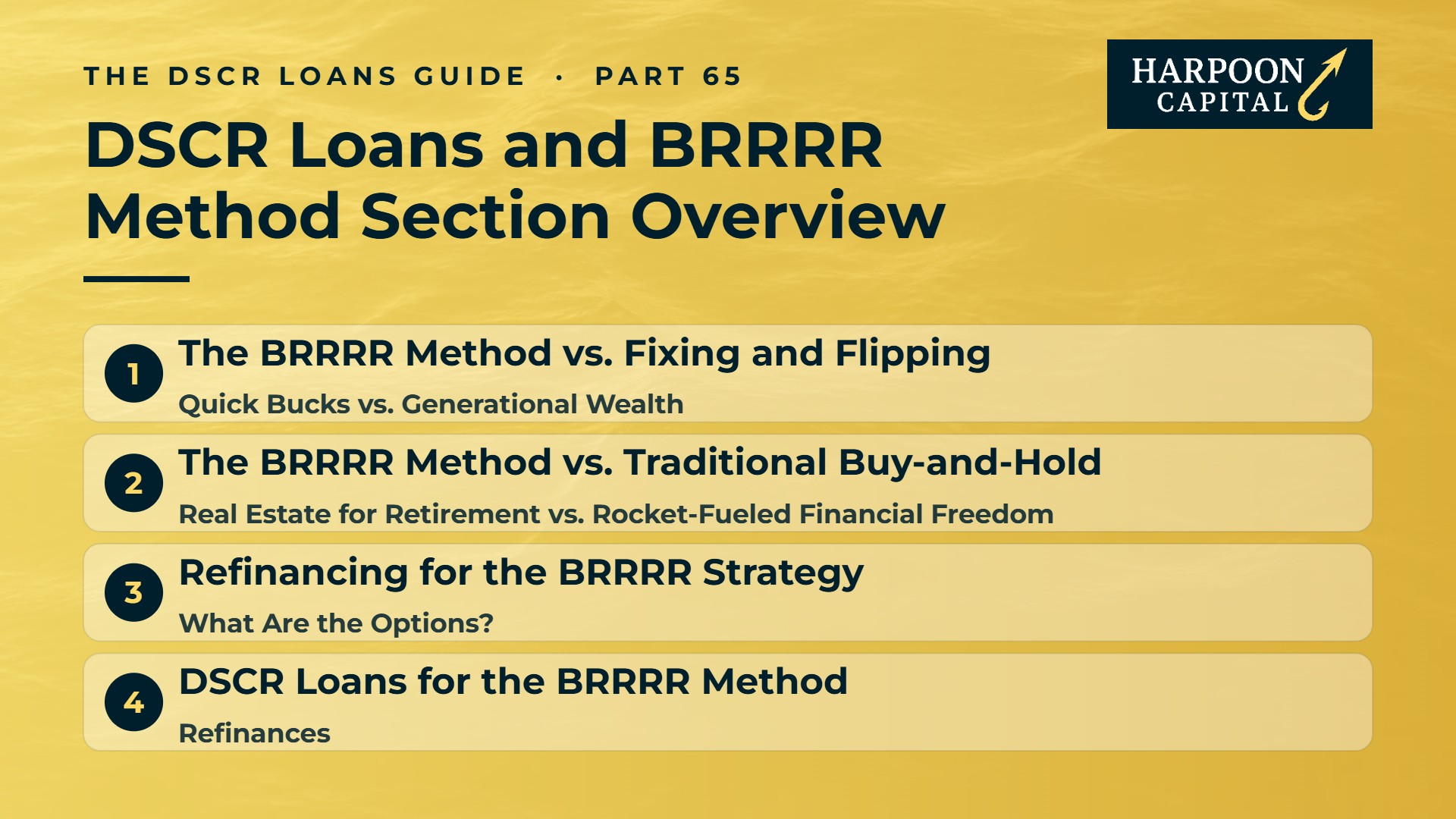
In this section, we'll take deep dives (including case studies) into:
The BRRRR Method vs. Fixing and Flipping: Quick Bucks vs. Generational Wealth
Refinancing for the BRRRR Strategy: What are the Options
DSCR Loans for the BRRRR Method (Refinances)

The BRRRR method has always been about more than buying cheap properties and fixing them up. Its true power lies in the ability to recycle capital, to take the same dollars, pull them back out through a refinance, and keep repeating the process until a single down payment has multiplied into an entire portfolio. What began as a creative niche strategy has, in the last few years, become the most efficient path to scale in residential real estate investing.
As seen throughout this section and with the case studies, the refinancing is the key step that unlocks the power of the BRRRR Strategy. Conventional loans, with their debt-to-income hurdles, property caps, and rigid seasoning requirements, can make even the best investor feel like they’re running in place. By contrast, DSCR Loans have transformed BRRRR from a clever acronym into a true engine of financial freedom.
The case studies make the difference crystal clear. Flippers like Franklin walk away with a single payday, and turnkey investors like Trina grow at a measured, retirement-friendly pace. But BRRRR investors like Bianca, especially those using DSCR loans, compound capital at lightning speed, adding properties, cash flow, and equity with every cycle. And as the different seasoning examples showed, even a few months shaved off the refinance clock can mean millions in extra value and dozens more properties over just five years. Speed, scale, and repeatability are the magic ingredients and DSCR loans have proven to be the financing vehicle that delivers all three.
© 2026 Harpoon Capital LLC. All Rights Reserved. WARNING: Unauthorized distribution, copying, or sharing of this guide is a violation of U.S. Federal Law and is punishable by civil penalties of up to $150,000 per violation. We aggressively enforce our intellectual property rights.