.png)


By Robin Simon, President, Harpoon Capital · About · LinkedIn · Author, The Book on DSCR Loans (Available on Amazon)
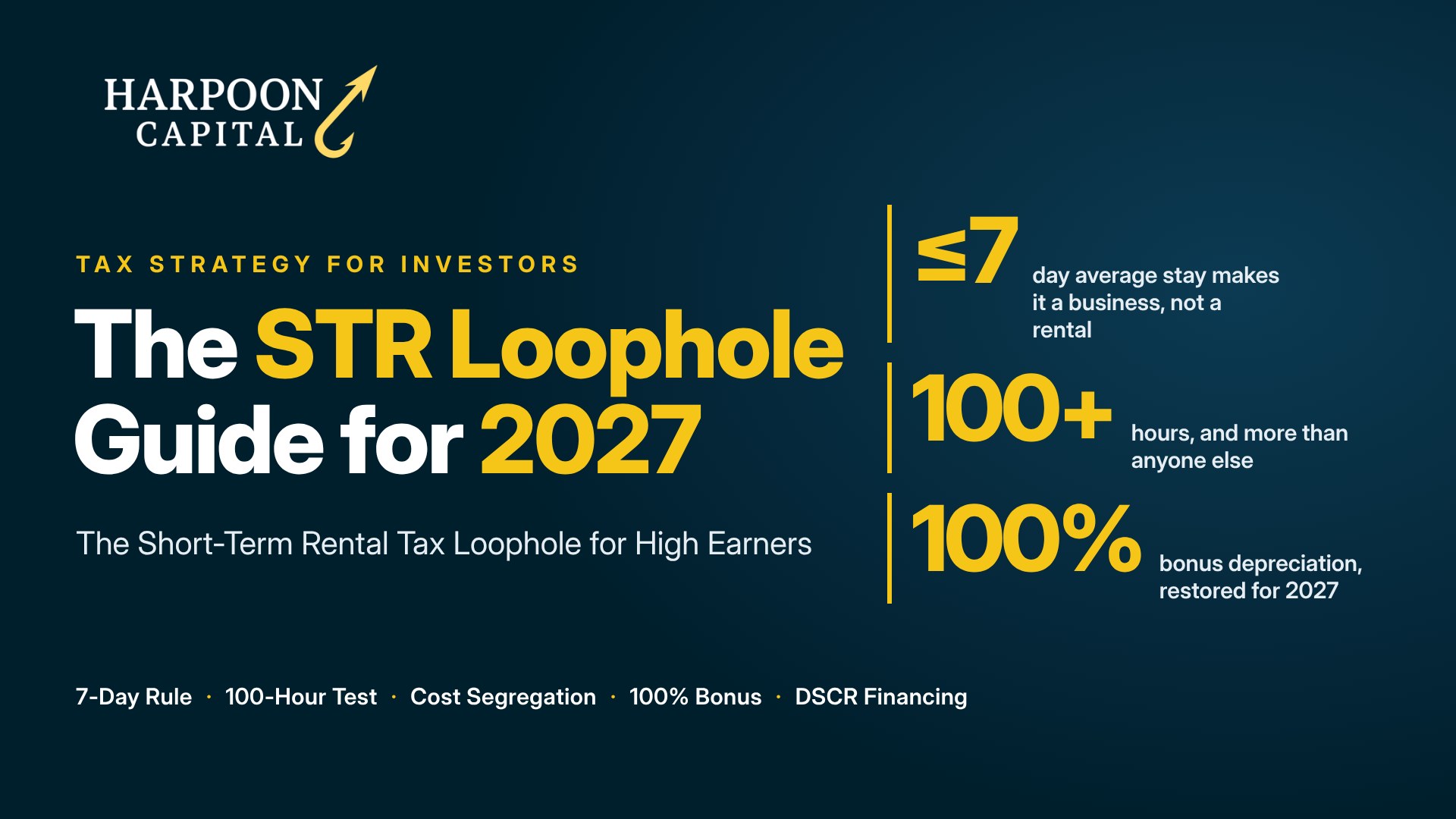
The short-term rental tax loophole (the “STR loophole”) lets a high earner (a business owner, a partner in a medical or law practice, a corporate executive, a professional athlete) with $500,000 or more of income use the paper losses from a short-term rental, usually created by a cost segregation study and 100% bonus depreciation, to offset ordinary income without qualifying as a real estate professional. It is not really a loophole at all. It is a 1988 Treasury regulation that treats a rental with an average guest stay of seven days or less as a business rather than a “rental activity,” and it is the single most consequential piece of tax law most high-income investors have never read.
Timing matters. With most of 2026 behind us, setting up a qualifying rental for this tax year is a tall order: the property has to be closed, furnished, listed and placed in service, with a well-documented 100-plus hours, all before December 31. For 2027, investors who plan now have the whole calendar. Unlike the $25,000 rental allowance, which disappears by $150,000 of income, the STR loophole has no income phase-out at all. The only real ceiling is the excess business loss rule, and it depends on how you earn your income, not how much: W-2 wages and investment income can absorb a capped amount of net loss each year ($512,000 for a married couple in 2026, with the excess carried forward), while for business owners, the STR loss generally offsets business income dollar for dollar before any cap applies. That difference is explained in full below, and it is the single most important thing for a business owner to understand about this strategy.
This guide covers the rule itself, the material participation tests (including the much-discussed 100-hour test), how to commission a cost segregation study, what 100% bonus depreciation under the One Big Beautiful Bill Act means for property bought in 2026 and 2027, the pitfalls that have sent taxpayers to the U.S. Tax Court and lost, and why the financing choice (a DSCR Loan rather than a second home loan) matters more here than in almost any other real estate strategy.
It is written from an unusual seat: a licensed Texas CPA who runs a DSCR lending company specializing in short-term rental loans and has used this exact strategy on his own Austin rentals. The strategy is powerful and entirely legal, but unforgiving of sloppiness, as a string of Tax Court decisions shows. Treat this guide as the briefing to read before meeting with a CPA, not a substitute for one.

Since the Tax Reform Act of 1986, Internal Revenue Code §469 has sorted every dollar of income and loss into “passive” and “non-passive” buckets. A loss from a passive activity can generally be deducted only against passive income, i.e. not against wages, bonuses, professional fees or portfolio income.
Rental real estate was singled out for the harshest treatment. Under §469(c)(2), a “rental activity” is passive per se, no matter how many hours the owner works: a surgeon who personally manages four long-term rentals is, in the Code’s eyes, a passive investor, and the depreciation losses sit suspended until there is passive income to absorb them or the properties are sold.
Congress carved out two exceptions, and neither helps a high earner. The $25,000 “active participation” allowance phases out completely between $100,000 and $150,000 of modified adjusted gross income. The real estate professional exception under §469(c)(7) (“REPS”) requires more than 750 hours in real property trades or businesses and more than half of all working time, which works for a full-time investor or a non-working spouse but is essentially impossible alongside a 2,000-hour day job (the Tax Court has not been persuaded otherwise!).
The short-term rental exception comes from Treasury Regulation §1.469-1T(e)(3)(ii), a temporary regulation issued in 1988 and still in force. It lists six situations in which an activity involving the rental of tangible property is not treated as a “rental activity” in the first place. The first two are the ones that matter:
If either applies, the property is not a rental activity at all. It is an ordinary business, like a hotel, and whether its loss is passive depends on the same material participation tests as any other business, which is where the 100-hour and 500-hour rules come in.

Key takeaway: The regulation was written for hotels and equipment-rental companies; Airbnb, which did not exist until 2008, simply fits the definition, and IRS Chief Counsel applied the same reading in CCA 202151005 (2021). “Loophole” gives it a whiff of impropriety it does not deserve, but the name has stuck.

The Tax Court looks at actual guest behavior, not how a listing is labeled. Under Treas. Reg. §1.469-1(e)(3)(iii), the “average period of customer use” is total days of customer use for the tax year divided by the number of bookings. It is measured each tax year, so a property can qualify one year and fail the next.
For example, a lake house that hosts 95 bookings totaling 310 nights in a year has an average stay of about 3.3 days and qualifies comfortably. A mountain STR that leans into monthly ski-season leases and hosts 14 bookings totaling 160 nights has an average stay of about 11.4 days and does not qualify, even if every one of those guests arrived through Airbnb.

A guest who extends a stay is generally one booking, and properties with very different nightly rates may need to be split into separate “classes” weighted by income, which rarely matters for a single house.
1. The mid-term rental drift. The “medium-term rental” model (30- to 90-day furnished stays for traveling nurses and relocating executives) is a fine business, and one the author operates, but it fails the seven-day test. A handful of 30-night shoulder-season bookings can quietly push the annual average past seven days, so track it monthly.
2. The master lease trap. If a manager or “arbitrage” operator master-leases the property and sublets nightly, the owner’s only customer is the manager and the exception is gone at the owner level. As Neil Langlois, CPA notes, the fix is an agency agreement, under which the guests remain the owner’s customers.
3. The 30-day alternative is narrower than it looks. Path (B) requires “significant personal services” beyond what landlords ordinarily provide; routine cleaning and repairs do not count, while daily housekeeping or concierge-style service might. For a typical whole-home rental, plan around the seven-day test.
This is the most misunderstood part of the strategy, and most STR loophole articles are written as if every reader were a salaried employee. The loophole itself has no income limit. The limit that exists comes from a separate rule, the excess business loss limitation in IRC §461(l), and it treats a business owner and a W-2 employee very differently.

Each year, Form 461 adds up all of your trade or business income and all of your trade or business deductions, including your STR’s depreciation. Only the net business loss left over is compared with the threshold: $256,000 for single filers and $512,000 for married couples filing jointly in 2026 (Rev. Proc. 2025-32), indexed for inflation after that. Whatever exceeds the threshold is not lost. It becomes a net operating loss (NOL) carryforward that can offset up to 80% of taxable income in later years. The One Big Beautiful Bill Act made the rule permanent.
Three details in the statute decide who is affected:
A married couple with $2,000,000 of K-1 profit from their company can generally deduct a $1,000,000 STR loss in full in the same year. Their business income absorbs the loss before the cap is ever tested, and they still have the $512,000 threshold available against wages or investment income on top of that.
A W-2 couple earning the same $2,000,000 can use $512,000 of that loss in 2026 and carries the other $488,000 forward as an NOL.
This follows the statute and the Form 461 instructions, but it is not a blank check: basis, at-risk and passive loss limits apply first, and the facts of each return matter. Have your CPA run the numbers.

| Who | Income type | Counts as business income? | What it means for an STR loss |
|---|---|---|---|
| Business owner | Schedule C or partnership K-1 profit from a company you own | YesNets first | The STR loss offsets that profit in full, plus up to $256,000 / $512,000 of other income. |
| Practice partner (physician, attorney, CPA, dentist) | Partnership distributive share and guaranteed payments | Generally yes (partners are not employees) | Same as a business owner. |
| S corporation owner | K-1 profit | Yes | The K-1 portion absorbs the STR loss before the cap is tested. |
| S corporation owner | The W-2 salary your own S corp pays you | No | Treated like any other wage. A large reasonable-compensation salary shrinks the uncapped room. |
| Executive, employed physician, tech employee | W-2 wages, bonus, RSUs | No | Net STR loss usable each year is capped at $256,000 / $512,000; the rest becomes an NOL. |
| Professional athlete or entertainer | Team salary (W-2 for MLB, NFL, NBA and NHL players) or studio salary | No | Capped like any W-2 income. |
| Professional athlete or entertainer | Endorsements, appearance fees and royalties through a loan-out company or Schedule C; tournament winnings for independent golfers and tennis players | Generally yes | That income absorbs STR losses before the cap is tested. |
| Investor or retiree | Interest, dividends, portfolio capital gains, pensions | No | Capped like W-2 income. |
For W-2 earners the cap is still large: $512,000 at the 37% rate saves roughly $189,000 of federal tax in a single year, and the excess carries forward. But business owners who have heard this strategy is “capped” are often leaving the biggest part of it on the table.

Because REPS asks two questions a working professional cannot answer honestly, and the STR exception asks neither.
REPS requires more than half of all working time to be in real property trades or businesses, plus the 750-hour floor; an attorney billing 1,900 hours would need more than 1,900 real estate hours on top. Spouses cannot combine hours to reach 750, and STR hours do not even help: because a seven-day property is not a rental activity, courts have refused to count its hours toward REPS (Bailey, T.C. Summ. Op. 2011-22) or to group it with REPS rentals (Eger, N.D. Cal. 2019), a trap Investor Friendly CPA flags in its REPS guide.
The STR exception removes the rental label entirely. The question becomes “did you materially participate in this business?”, which can be met with a few hundred hours, combined across both spouses, no matter how many hours were spent at the hospital or the law firm.
Key takeaway: The person with the highest marginal rate, the least free time and no realistic path to REPS is exactly the person the seven-day rule serves best. Ironically, the rule was written for hotel operators who have never heard of it!
A side benefit: in later profitable years, a qualifying STR’s income is non-passive and generally outside the 3.8% net investment income tax under §1411, although that is its own analysis to confirm with your CPA.

Treas. Reg. §1.469-5T(a) provides seven tests, and meeting any one of them for the year makes the activity non-passive. Three are realistic for an STR owner, two are occasionally useful and two are irrelevant.
| Test | Rule (paraphrased from §1.469-5T(a)) | Practical fit for an STR owner |
|---|---|---|
| 1 | More than 500 hours in the activity during the year | The gold standard; hard with one property, realistic with three or more or a heavy self-managed renovation year |
| 2 | Participation is “substantially all” of the participation of all individuals, including non-owners | Only for the true self-manager who also cleans; a paid cleaner usually defeats it |
| 3 | More than 100 hours and not less than the participation of any other individual | The workhorse test.Most used The owner must out-work every cleaner, co-host, handyman and manager, individually |
| 4 | More than 100 hours in each of several “significant participation” activities, totaling more than 500 hours | For an owner with several 100-plus-hour businesses; rare |
| 5 | Materially participated in 5 of the prior 10 years | Protects a long-held property once the first five years are banked |
| 6 | Personal service activity, 3 prior years | Not applicable to rentals |
| 7 | Regular, continuous and substantial participation based on all facts and circumstances | Not available with 100 hours or less; management hours do not count if anyone else is paid to manage or spends more time managing (§1.469-5T(b)(2)) |
Under §469(h)(5), a spouse’s participation counts as the taxpayer’s, whether or not the spouse is on title or the couple files jointly. A surgeon who logs 40 hours and a spouse who logs 90 are at 130 hours for Test 3. As Investor Friendly CPA puts it, spousal hours cannot be combined for REPS but can be for material participation.
This is the most useful planning fact in the strategy for two-career households, and the reason Michael Chang of STR Like The Best (an investor and educator, not a CPA) frames the 100-hour approach as a “strategy for W-2 couples.” It works just as well for a business-owner couple.
Test 3 compares the owner against each other person separately, not against all of them combined. If the owner logs 140 hours, the cleaner logs 120 and the handyman logs 60, the owner passes. If a full-service property manager logs 200 hours, the owner fails Test 3 and is left trying to prove 500 hours under Test 1.

The IRS Passive Activity Loss Audit Technique Guide tells examiners to look specifically for paid managers and “investor” hours when Test 3 is claimed.

Here is where the strategy is won or lost, and where the published guidance is often vague. The rule is that work done by an owner “in connection with” the activity generally counts, with three exclusions the IRS and the Tax Court enforce vigorously.
Under §1.469-5T(f)(2)(ii)(B), reviewing statements and monitoring finances “in a non-managerial capacity” are excluded. Reading the Airbnb payout report over coffee is not participation; repricing the weekend, messaging guests, scheduling the cleaner and fixing the hot tub are.
Moss v. Commissioner, 135 T.C. 365 (2010), refused to count hours spent being available to tenants, and Mirch v. Commissioner, T.C. Memo. 2025-128, applied that to a short-term rental in late 2025.
The Mirches, two Reno attorneys, rented a vacation home next door about 23 times in a year and produced an undated log claiming 944.5 hours, built from standardized blocks: 7 hours of cleaning per turnover (while also paying professional cleaners) and 8 hours of “site management” for every rented day, described as being on call. The court threw out the cleaning and on-call hours and found they had not proven even 100. The property was an agreed short-term rental; the owners simply could not prove they materially participated, and that is the whole game.
Work not customarily done by an owner, done mainly to meet the hours test, does not count (§1.469-5T(f)(2)(i)). In Lee v. Commissioner, T.C. Memo. 2006-193, 24 hours to replace four miniblinds and 56 hours to install a toilet were not credible. The Tax Court has a sharp eye for round numbers.
Courts have allowed reasonable, documented travel among properties (Leyh, T.C. Summ. Op. 2015-27) but treated a long drive to a distant property as commuting (Truskowsky, T.C. Summ. Op. 2003-130). Log each trip’s business purpose and treat long drives as the weakest hours in the log.
| Case | Facts | Result | Lesson |
|---|---|---|---|
| Moss, 135 T.C. 365 (2010) | Claimed hours for being available to tenants | Hours disallowed | Availability is not work |
| Pohoski, T.C. Memo. 1998-17 | Hawaii STR condos run through a management company | Won on one condo; lost on the other with under 100 hours and no evidence of anyone else’s hours | Document everyone else’s time, not just your own |
| Lee, T.C. Memo. 2006-193 | 24 hours for blinds, 56 hours to install a toilet | Log not credible | Implausible entries sink the whole log |
| Leyh, T.C. Summ. Op. 2015-27 | Reconstructed travel among 12 rentals | Travel hours allowed | Specific, proportionate travel can count |
| Lucero, T.C. Memo. 2020-136 | California STR run by a management company; owner set rates and approved expenses over $100 | §469 limited the losses | An after-the-fact log, no proof of 100 hours and no evidence of the manager’s hours |
| Mirch, T.C. Memo. 2025-128 | 944.5-hour log of standardized blocks, mostly on-call time | Failed to prove even 100 hours | Round numbers and on-call time do not survive |

The honest answer is “as many as you actually worked, recorded as you worked them.” The strategic answer is to design the first year so the real number lands comfortably above 100 with a margin.
A self-managed whole-home STR typically generates 150 to 300 legitimate owner hours in year one, concentrated in setup: furnishing, photographing and writing the listing, pricing, onboarding cleaners and handling the first few dozen guest conversations.
Later years are leaner, which is why owners often add a second property, or convert to long-term after banking five years of material participation under Test 5.
1. Keep a contemporaneous log. The regulation allows participation to be shown “by any reasonable means” (§1.469-5T(f)(4)), but every losing taxpayer lost on credibility. A running log in a spreadsheet, calendar or purpose-built app such as REPSLog, with the date, task, time and supporting artifact (message thread, receipt, cleaner’s invoice), is what credibility looks like.
If you are using the STR loophole, your time log is your audit defense. REPSLog is time-tracking software built specifically to document hours for REPS and the short-term rental loophole, so your log is contemporaneous and organized from day one instead of reconstructed in April. It is our top recommended app for investors using this strategy.
Start Tracking with REPSLog ↗Mar 14, 2027 · 1.5 hrs · Owner (Sarah) · Lake houseMar 15, 2027 · 2.0 hrs · Cleaner (Maria) · Lake houseMarch · 40 hrs · “Managed property”2. Log everyone else’s hours too. Test 3 cannot be proven without evidence of the cleaner’s, co-host’s and handyman’s time. A 2.5-hour turnover times 95 turnovers is 237.5 hours; an owner who does not know that number cannot show the court that 140 beats it. In Pohoski, that missing evidence cost the taxpayers one of their two condos.
3. Start the clock early, but know where the gray area is. Setup hours (furnishing, photography, the listing, onboarding the cleaner) count even before the first guest. Hours before the purchase (researching markets, touring, financing) are less settled: some CPAs, including Stephen Nelson in this Evergreen Small Business article, read Treas. Reg. §1.469-4(b)(1) to count work “conducted in anticipation of” the business, while others treat it as investor-type time. With no Tax Court decision squarely on point, plan to clear 100 hours without it.
4. Beware the December closing. A December purchase placed in service before year-end captures a full year of bonus depreciation, but the owner must still materially participate in that year, usually by proving 100 hours, a hard story in three weeks (the “substantially all” test is the main alternative for an owner who does nearly all the work personally). A furnished, listed, bookable property with 110 documented setup hours can hold up; 20 hours and a January go-live will not.
Watch out: Nearly every losing case in this area turned on substantiation, not on the rule itself. The three habits that have failed in court are reconstructing hours after the fact, using standardized blocks (7 hours per turnover, 8 hours per rented day) and counting availability rather than work.

Depreciation is the engine of the strategy, and cost segregation is the turbocharger. A long-term rental is depreciated over 27.5 years. A short-term rental usually gets a slower schedule: guests stay on a “transient basis,” so it generally falls outside the definition of residential rental property (§168(e)(2)(A)) and is treated as 39-year nonresidential property, like a hotel. A $960,000 STR building therefore produces only about $24,600 a year. (Converting to long-term rental changes the recovery period; WCG explains the mechanics.)
A cost segregation study (“cost seg”) is an engineering-based analysis that breaks the purchase price into its components and assigns each to the shortest recovery period the law allows:
For a single-family or small multifamily rental, studies typically reclassify 20% to 30% of the depreciable basis, with furnished STRs (furniture, pools, hot tubs, finishes) at the higher end. Those reclassified assets qualify for bonus depreciation; the 39-year structure never does.

Land is never depreciable, so the land share of the purchase price does nothing for this strategy. An STR whose value comes mostly from its address, like a bungalow in a prime Austin neighborhood or a condo in Miami Beach, can easily carry a land allocation of 40% or more, which shrinks the depreciable basis and every number downstream of it. An A-frame, lake house or ranch-style STR in a rural market is the opposite: the land is comparatively cheap, so most of the purchase price is building, furnishings, decks, hot tubs and site improvements, which is exactly what a cost segregation study reclassifies.
The difference is large. On a $1,000,000 purchase, moving from a 40% land allocation to 15% adds $250,000 of depreciable basis, which at a 28% reclassification rate is roughly $70,000 more first-year deduction. In other words, all else equal, rural and resort-area properties tend to get more out of the STR loophole than urban ones.

Roughly half of DSCR Lenders do not lend on rural properties at all, and many that do cap leverage at 65% to 70% LTV (see our guide to Rural Properties and DSCR Loans). Harpoon Capital’s Rural-Friendly DSCR Loans go further than most other DSCR Lenders allow:
The IRS Cost Segregation Audit Techniques Guide treats a detailed engineering approach with a site inspection as the quality standard and singles out “rule of thumb” allocations for challenge. The market offers three tiers:
RE Cost Seg designs cost segregation studies specifically for the STR loophole, with engineered reports built to stand up to the IRS Audit Techniques Guide. Harpoon Capital readers save 10% on their study through our link.
Get a Cost Seg Quote & Save 10% ↗Whichever tier, the report should document the land allocation, list each asset with its cost and class life, and tie to the purchase price plus capitalized closing costs. The fee itself is deductible.
Order the study in the first year the property is placed in service if you can. A property placed in service earlier can still be studied: Form 3115 and a §481(a) catch-up adjustment let the owner take all the missed depreciation in the year of change, generally without amending returns (if only one return has been filed, amending may be simpler). The bonus rate follows the original placed-in-service year.
A study generally makes sense when first-year tax savings are many multiples of the fee, which for a 32% to 37% bracket owner holding five-plus years is almost any property over roughly $300,000. It makes less sense for a short hold (recapture comes back on sale) and is wasted if the material participation test is not met, so order it after the hours plan is realistic.
Bonus depreciation under §168(k) lets a taxpayer deduct a percentage of the cost of qualifying property (i.e. property with a recovery period of 20 years or less) in the year it is placed in service, instead of spreading it over the recovery period.
The 2017 Tax Cuts and Jobs Act phased 100% bonus down after 2022 (80%, 60% and 40% in 2023 through 2025). The One Big Beautiful Bill Act (“OBBBA”), signed July 4, 2025, restored 100% bonus permanently for property acquired and placed in service after January 19, 2025; the IRS issued interim guidance in Notice 2026-11.
1. “Acquired” means the binding contract date, not closing. The acquisition date is when the written binding contract became enforceable with contingencies cleared. For 2026 and 2027 buyers it is a non-issue, but it is why some early-2025 deals got 40% instead of 100%.
2. Used property qualifies. A 1998 lake house bought in 2027 gets the same treatment as new construction, provided the buyer had not used it before.
3. The structure never qualifies. Only the 5-, 7- and 15-year assets identified in the cost segregation study, plus any separately purchased furniture and equipment, are eligible. The building shell still depreciates over 39 years (27.5 for a long-term rental).
4. “Placed in service” means ready and available for its intended use. For an STR, that means furnished, listed and bookable, not merely owned. It controls when bonus can be claimed; it is not necessarily when hours start counting (see above).
Separately purchased furniture is 5- or 7-year property and qualifies for 100% bonus on its own, and small items can often be expensed under the $2,500 de minimis safe harbor. Section 179 is also available for furnishings in a rental that rises to a trade or business, but bonus is simpler because it has no business-income limit and can create a loss.
Texas, where Harpoon Capital is based, has no personal income tax, so the federal answer is the whole answer. California, New York, New Jersey and Pennsylvania, among others, do not allow federal bonus depreciation on the state return, so the deduction there is spread over the assets’ normal lives. High earners in those states should model both returns.
To illustrate, take a hypothetical high-earning couple buying in 2027:

| Component | Basis | Treatment | 2027 deduction |
|---|---|---|---|
| 5-, 7- and 15-year property from the study | $268,800 | 100% bonus | $268,800 |
| Furniture, equipment and small wares | $45,000 | 100% bonus / de minimis | $45,000 |
| 39-year structure | $691,200 | 39-year straight line, mid-month (placed in service June) | about $9,600 |
| Total first-year depreciation | about $323,400 |
If rental income roughly covers operating costs and interest (common in year one for a well-bought STR), the activity reports a net loss of roughly $323,000, which is non-passive because the property passes the seven-day test and the couple materially participates.
With taxable income well inside the 37% bracket (which for 2026 begins at $768,700 for joint filers) and the deduction reaching into the 35% bracket, the federal tax saved is roughly $115,000. In Texas, that is the whole saving.

Key takeaway: Simply put, the couple financed roughly 40% to half of their down payment with Uncle Sam’s share of their own paycheck, which is a rare instance of the IRS helping with closing costs!
The excess business loss cap. This couple’s income is all W-2, so their net STR loss is tested against the §461(l) threshold ($512,000 joint for 2026). Their $323,000 loss fits under it; a single filer would deduct $256,000 and carry $67,000 forward. A business-owner couple with $900,000 of K-1 profit would not hit the cap even at three times the loss. (The 2026 thresholds are lower than 2025’s $313,000 / $626,000 because OBBBA reset the indexing base.)
Capture the savings during the year. Adjust W-4 withholding or quarterly estimates based on your CPA’s projection, turning April’s refund into monthly cash flow, but not on the back of an envelope, since underpayment penalties apply if the deduction does not materialize.
This is a timing benefit, not a permanent one. Accelerated depreciation is recaptured on a taxable sale, so the strategy trades a 37% deduction today for a 25% (or up to 37%) tax later, deferred as long as you hold. A very good trade, but not a free one.
A second home loan’s occupancy covenant requires the property to be kept primarily for your personal use, which is the opposite of the full-time rental this strategy depends on. A DSCR Loan qualifies on the property’s rental income, ignores the six-figure paper loss on your return and is built for a full-time short-term rental.

Financing is where this strategy departs most sharply from vacation-home ownership, and where the author’s two professions overlap. A property that qualifies for the STR loophole is, by definition, a business asset: rented nightly to the public, used personally for fewer than 15 days, often held in an LLC and run with cleaners and vendors. The loan products most buyers reach for first were designed for the opposite.
A conventional “second home” loan (the 10% down product Fannie Mae and Freddie Mac offer for vacation homes) is cheaper than an investment property loan and easier to qualify for, which is why it is so tempting. It is also, in the words of Fannie Mae’s Selling Guide, restricted to a property that “must be occupied by the borrower for some portion of the year,” over which “the borrower must have exclusive control,” which “must not be rental property or a timeshare arrangement,” and which “cannot be subject to any agreements that give a management firm control over the occupancy of the property.” Fannie Mae permits some rental income on a second home, but the income cannot be used to qualify and the occupancy requirements still apply.
The loan documents are even more direct. The Second Home Rider every borrower signs at closing (Fannie Mae/Freddie Mac Form 3890, 07/2021) replaces the occupancy covenant of the mortgage with this one:
“Borrower must occupy and use the Property as Borrower’s second home. Borrower will maintain exclusive control over the occupancy of the Property, including short-term rentals, and will not subject the Property to any timesharing or other shared ownership arrangement or to any rental pool or agreement that requires Borrower either to rent the Property or give a management firm or any other person or entity any control over the occupancy or use of the Property. Borrower will keep the Property available primarily as a residence for Borrower’s personal use and enjoyment for at least one year after the date of this Security Instrument…”
Read that against the strategy in this guide. The STR loophole requires keeping personal use to no more than the greater of 14 days or 10% of rented days; the rider requires the property to be kept “primarily” for the borrower’s personal use. The strategy is built around guests; the rider names “short-term rentals” specifically in the exclusive-control clause.
A borrower who signs the rider intending to run the property as a full-time nightly rental has made a false statement to a federally related lender, and here the author will speak plainly as a lender: that is occupancy fraud, not a gray area. Under 18 U.S.C. §1014, knowingly making a false statement to influence a federally insured lender carries penalties of up to 30 years and $1,000,000. Prosecutions of individual borrowers are rare, but the civil consequences are not: the lender may accelerate the loan, foreclose or re-price it retroactively, and the detection tools (automated scans of Airbnb and VRBO listings, address cross-checks against voter and tax records) have become routine. For a high earner with a professional license and a reputation to protect, a slightly better interest rate is a remarkably poor trade for that exposure.
Even setting the legal question aside, the economics have narrowed. Since April 1, 2022, Fannie Mae and Freddie Mac have charged loan-level price adjustments on second homes of roughly 1.125% to 4.125% of the loan amount, and in Fannie Mae’s current pricing matrix that add-on matches the one for investment properties. The rate advantage that once made the gray area tempting is mostly gone. Harpoon Capital’s DSCR Loans Guide covers the full comparison in DSCR Loans vs. Second Home (“10% Down”) Loans for STRs.
The honest alternative within the conventional world is an investment property loan: 15% to 25% down, no occupancy covenant and rental use permitted. It is a perfectly legitimate choice, and it has two structural problems for the reader of this guide, both covered in the video above from Part 2 of our DSCR Loans Guide.
First, conventional loans qualify the borrower on debt-to-income (“DTI”) using tax returns, and the whole point of this strategy is to produce tax returns showing a six-figure loss. Underwriters add depreciation back when calculating income from Schedule E, but the process is slow and the treatment of short-term rental income is conservative. A newly furnished STR with no history generally cannot count its projected income at all, and a 1007 “market rent” appraisal form does not capture nightly rates. A borrower with K-1s, bonuses and multiple properties can spend weeks assembling documents for an underwriter who will ultimately qualify the loan on the day job.
Second, conventional loans must be held in the borrower’s personal name, cap out at ten financed properties and report on the personal credit report, none of which suits an investor who intends to scale.

A DSCR Loan (Debt Service Coverage Ratio) qualifies the loan on the property’s own income rather than the borrower’s personal income or tax returns, which is why it has become the “go-to” product for short-term rental investors. The fit with the STR loophole is close to perfect, for five reasons:
However, the trade-offs are real and should be understood. DSCR Loans for short-term rentals commonly require 20% to 25% down (many lenders still set STR leverage about 5% below their long-term rental maximums, although Harpoon Capital offers 15% down on STR purchases through its standard DSCR program and, where the property’s projected income alone falls short, a newer “Hybrid DSCR” option that adds the borrower’s personal income or liquid assets to boost qualification to the same 85.0% LTV), carry rates somewhat above conventional, and usually include a prepayment penalty of up to five years (a no-prepay option is generally available at a higher rate). For a buyer planning to hold through the recapture horizon anyway, the prepayment penalty is rarely binding, and the rate difference is typically a fraction of the first-year tax saving.
Key takeaway: The STR loophole only works if the property is run as a full-time rental business, and a DSCR Loan is built for exactly that. It qualifies on the property’s rental income, so the six-figure paper loss on your tax return does not count against you, and it has no occupancy covenant, so renting nightly all year does not put you in breach of the loan.

The STR loophole fails in predictable ways, and almost all of them are avoidable with planning. In rough order of frequency:
Under §280A(d)(1), a dwelling is treated as the taxpayer’s residence for the year if personal use exceeds the greater of 14 days or 10% of the days it was rented at fair market rent. Cross that line and §280A(c)(5) limits the rental deductions to the rental income, which kills the loss entirely for that year.
Personal use includes family members (even paying ones), anyone paying below-market rent and swaps; days spent substantially full-time on repairs do not count. A “family lake house that also does some Airbnb” is a poor candidate for this strategy.
A few 30-night bookings in a slow season can push the annual average past seven days. Set a minimum and maximum stay on the listing with the arithmetic in mind, and review the running average quarterly.
A full-service manager will almost always out-log the owner, eliminating Test 3 and leaving only the 500-hour test. Self-management through a platform, with separately engaged cleaners and handymen, is the structure the strategy was built around; a hybrid in which the owner keeps messaging and pricing can work if the manager’s hours are documented and beaten.
Nearly every losing case (Moss, Lucero, Mirch, Lee, Pohoski) turned on substantiation.
REPSLog is the hours tracker we recommend for the STR loophole: log the task, time and notes as you work, so the record exists before anyone asks for it.
Try REPSLog ↗A short-term rental is not a “rental activity,” so it cannot be folded into a REPS taxpayer’s election to group all rental real estate (§1.469-9(g)). Keep STRs as their own activity, separate from long-term rentals.
Converting a qualifying STR to 12-month leases makes it a rental activity again, and future losses become passive. Bank five years of material participation first so Test 5 protects the activity.
Most whole-home STRs that provide only cleaning between stays report on Schedule E with no self-employment tax (consistent with CCA 202151005). Daily housekeeping, meals or concierge service can move it to Schedule C and a 15.3% tax on profitable years, and the seven-day test does not require them.
None of this matters if the city does not allow a non-owner-occupied STR at that address. Austin, Nashville, Asheville and many resort towns cap licenses or ban them outright. Confirm the permit path before the earnest money goes hard.
Watch out: The first three pitfalls (personal use, average-stay drift and a manager who out-works you) are decided by how the property is run, not by how the return is prepared. No CPA can fix them in April.
Accelerated depreciation is a loan from the Treasury, and the sale is when it comes due. Gain on 5- and 7-year property is recaptured as ordinary income under §1245; bonus taken on 15-year land improvements is recaptured as ordinary income to the extent it exceeds straight line; and straight-line depreciation on the structure is “unrecaptured §1250 gain” taxed at up to 25%. Remaining appreciation is long-term capital gain, plus the 3.8% net investment income tax where it applies.
On the $1,200,000 example, a sale after five years would carry well over $300,000 of recapture-type gain. Investors usually handle it one of three ways:
1. Hold. The deferral has no expiration date, and a well-located short-term rental that cash flows can be held, refinanced and passed on. Assets held until death receive a stepped-up basis under §1014, which eliminates the recapture entirely for heirs.
2. Exchange. A §1031 exchange defers gain on real property, but furniture and other personal property are no longer eligible and are taxable “boot,” the “like-kind exchange wrinkle” WCG describes. Have the cost segregation firm and the qualified intermediary talk well before closing.
3. Harvest. Sell in a low-income year (a sabbatical, retirement, a business loss elsewhere) so recapture lands in a lower bracket.
And if the STR slipped into passive status in a later year, any suspended losses are freed on a fully taxable sale under §469(g).

For a high earner planning a 2027 purchase, the sequence matters as much as the pieces:
A rough estimate of how much of a short-term rental's purchase price a cost segregation study might reclassify into bonus-eligible 5-, 7- and 15-year property.
Disclaimer. This calculator produces a rough, illustrative estimate based on typical reclassification percentages for residential property. It is not a cost segregation study, does not analyze your property's actual components and does not constitute tax advice. Actual results depend on the specific property, its construction and finishes, the land allocation, the study methodology and current law. Bonus depreciation eligibility depends on the acquisition (binding contract) date and the placed-in-service date. Consult a qualified cost segregation professional and your CPA before relying on any figure. Harpoon Capital is a lender, not a tax advisor, and does not prepare cost segregation studies.
Estimates the federal (and optional flat state) tax saved in year one when a qualifying short-term rental loss offsets ordinary income, using 2026 brackets and the 2026 excess business loss cap.
Disclaimer. This calculator is an educational illustration only and is not tax, legal or financial advice. It applies 2026 federal ordinary income brackets and standard deductions (Rev. Proc. 2025-32) and the 2026 excess business loss thresholds under IRC §461(l) ($256,000 single / $512,000 joint); 2027 figures will be inflation-adjusted. It ignores itemized deductions, the alternative minimum tax, the 3.8% net investment income tax, the qualified business income deduction, credits, phase-outs, state non-conformity to bonus depreciation, at-risk and basis limitations, depreciation recapture on sale and whether you in fact meet the material participation and average-stay requirements. If the STR does not qualify as non-passive, the loss is generally suspended and the savings are zero in the current year. Your actual results will differ. Consult a licensed CPA before acting. Harpoon Capital is a lender, not a tax advisor.
It is the combination of two rules. First, Treas. Reg. §1.469-1T(e)(3)(ii)(A) says a property whose average guest stay is seven days or less is not a “rental activity,” so its losses are not automatically passive. Second, if the owner materially participates, those losses are non-passive and can offset wages, business income and investment income on the same return. Pair that with a cost segregation study and bonus depreciation, and a single STR purchase can produce a first-year loss of 20% to 30% of the depreciable basis that reduces tax on other income. “Loophole” is a nickname; it is an exception written into the regulations in 1988.
Yes. The short-term rental exception in Treas. Reg. §1.469-1T(e)(3)(ii)(A) has been in force since 1988 and was not changed by the One Big Beautiful Bill Act. If anything, the strategy became more valuable in 2025 when OBBBA permanently restored 100% bonus depreciation for property acquired after January 19, 2025. As of this writing, no enacted change affects it, though investors should assume that could change.
Add up the total nights rented for the year and divide by the number of separate bookings. If the result is seven days or less, the property is not a rental activity under §1.469-1T(e)(3)(ii)(A). A second path allows an average stay of 30 days or less if you provide significant personal services such as daily cleaning, concierge or meals, which most hosts do not. One 28-night booking in a year of 40 three-night stays will not break the test, but a few monthly winter tenants can. Track it monthly, not at year-end.
It is the third of the seven material participation tests in Treas. Reg. §1.469-5T(a): the owner participates for more than 100 hours in the year and no other individual (including cleaners, co-hosts, handymen and managers) participates more. Spousal hours combine. It is the most commonly used test because most self-managed single STRs generate well over 100 owner hours in the first year.
Hours spent on the day-to-day work count: guest messaging, pricing, listing management, turnovers you do yourself, repairs, buying furnishings, coordinating vendors, bookkeeping tied to operations. Hours spent as an investor do not, under §1.469-5T(f)(2)(ii)(B): reviewing financial statements, monitoring the manager, and planning in a non-managerial capacity. Travel time is contested and most advisors leave it out. Keep a contemporaneous log with dates, tasks and durations, and keep your cleaner’s and co-host’s invoices, because under the 100-hour test you have to show you out-worked them. Reconstructed logs built after an audit notice have lost in Tax Court repeatedly.
No, and this is the whole point. Because a property with an average stay of seven days or less is not a “rental activity,” the real estate professional rules of §469(c)(7) do not apply to it. The owner only needs to materially participate under one of the seven general tests.
Yes, but it is harder. A manager’s hours count against the owner under Test 3, so a full-service manager usually pushes the owner to the 500-hour test. A hybrid arrangement in which the owner keeps guest communication, pricing and vendor management, and documents both sides’ hours, can work.
Yes. Under §469(h)(5), a spouse’s participation is attributed to the taxpayer whether or not the spouse owns an interest in the property and whether or not the couple files jointly. (Spousal hours do not combine for the separate 750-hour real estate professional test, which is one more reason the STR route suits two-career households.)
Yes, if the property is placed in service (listed and available for guests) by December 31 and you materially participate for the year. Depreciation, including bonus, is allowed for the year the property is placed in service regardless of the month. The hours are the constraint: 100 hours is hard to reach in November, so late-year buyers either document a heavy, well-logged setup period or rely on the “substantially all” test in §1.469-5T(a)(2), which is met if you personally do nearly all of the work with no manager or co-host. Furnishing, setup, listing creation and guest communication in December all count.
Keep personal use to no more than the greater of 14 days or 10% of the days rented at fair market rent, per §280A(d)(1). Days spent working substantially full-time on repairs and maintenance do not count as personal use. Exceeding the limit converts the property to a “residence” for the year and caps deductions at rental income.
Yes. Both the average-stay test and material participation are measured each tax year. A loss you deducted in a year you qualified is not clawed back if you fail the test later, but the property’s income and losses in the failing year are passive. That matters most in year two and beyond, when the property is often profitable: a profitable STR that is passive produces passive income, which can absorb passive losses from other rentals. Some owners let the property go passive once the big year-one depreciation has been taken, while others keep qualifying for five years so Test 5 protects the activity later; which is better depends on your other passive income.
Typically 20% to 30% of the depreciable basis (purchase price plus capitalized costs, less land) for single-family and small multifamily property, with furnished STRs and properties with pools, extensive landscaping or recent renovations at the higher end. Furniture bought separately is 100% bonus-eligible on top of that.
Yes, with a catch. A cost segregation study on a property placed in service in a prior year is a change in accounting method filed on Form 3115, which lets you take the missed depreciation as a one-time §481(a) adjustment in the current year without amending past returns. The bonus percentage follows the year the property was originally placed in service, so a property placed in service in 2023 or 2024 gets 80% or 60% bonus, not 100%. The 7-day and material participation tests are measured in the year you claim the deduction, so a long-term rental converted to an STR this year can qualify this year.
No. The $25,000 rental loss allowance for active participants phases out between $100,000 and $150,000 of income under §469(i), and the real estate professional route requires 750 hours, but neither applies here. A non-passive STR loss offsets income at any level. The only ceiling is the excess business loss limit in §461(l) discussed below, which is a cap on the size of the deduction, not on who can take it.
It depends on how you earn your income. There is no income phase-out, but the excess business loss rule in §461(l) caps the net business loss you can deduct each year at $256,000 (single) or $512,000 (joint) for 2026. For W-2 earners and investors, that cap applies to the STR loss directly, because wages and portfolio income are not business income; anything above it carries forward as a net operating loss. For business owners, the STR loss is first netted against Schedule C, partnership and S corporation K-1 income, and only a net loss left over is tested against the cap, so the usable deduction can be much larger. That is how the statute and the Form 461 instructions read, but the rule has little case law, guidance on some details is thin and advisors take different positions on some edge cases. Basis, at-risk and passive loss limits also apply first, so have a CPA model your own return before relying on a specific number.
In practice it can come close: the usable loss is limited mainly by the amount of business income plus the threshold. The excess business loss rule in §461(l) nets all trade or business income against all trade or business deductions, so an STR loss first offsets Schedule C, partnership and S corporation K-1 income before any cap applies. Only the net business loss left over is limited ($256,000 single / $512,000 joint for 2026). W-2 wages and investment income do not count as business income, so salaried earners reach the cap sooner; any excess carries forward as a net operating loss. Confirm the calculation with your CPA.
Yes. A non-passive loss from a short-term rental lands on Schedule E, flows to Form 1040 and reduces adjusted gross income, which means it offsets salary, bonus and RSU income taxed at the top brackets. It can also reduce the 3.8% net investment income tax, since lowering modified AGI lowers the amount subject to it. For a married couple in the 37% bracket, a $300,000 first-year loss is roughly $111,000 of federal tax plus state tax.
Usually 39. A long-term residential rental uses 27.5 years, but §168(e)(2)(A) excludes units used on a “transient basis” from residential rental property, and the prevailing practice is to depreciate a short-term rental with stays of 30 days or less over 39 years, like a hotel. That slows depreciation on the building itself, which is one more reason the cost segregation study (and the bonus-eligible 5-, 7- and 15-year property it identifies) does most of the work in this strategy. Confirm the classification with your CPA.
It is recaptured: gain on 5- and 7-year property (and bonus taken on 15-year land improvements, to the extent it exceeds straight line) is ordinary income, and straight-line depreciation on the structure is taxed at up to 25% as unrecaptured §1250 gain. A §1031 exchange defers the real-property portion but not the personal property, and a step-up in basis at death eliminates it. Plan to hold.
Usually not. STR income is reported on Schedule E and is not subject to the 15.3% self-employment tax unless you provide substantial services to guests beyond what a landlord provides, such as daily housekeeping, meals or concierge, under Reg. §1.1402(a)-4(c). That is the same “significant personal services” line that governs the 30-day version of the 7-day rule, and it cuts both ways: most owners are better off staying on Schedule E. If you do provide those services, the activity goes on Schedule C and becomes a trade or business, which has other consequences for the §461(l) netting discussed above.
Not always. Material participation and the 7-day rule flow through to most state returns, but bonus depreciation does not: California, Pennsylvania and a number of other states require an add-back and depreciate the property on their own schedules, so the state deduction arrives over years instead of in year one. Some states also have their own version of the excess business loss limit. The federal savings are usually the bulk of the benefit, but model the state side before buying in a non-conforming state.
A DSCR (Debt Service Coverage Ratio) loan qualifies a property primarily based on the property (its rent, value and location) relative to its mortgage payment, rather than the borrower’s personal income or tax returns. If the property’s projected or actual rent covers the mortgage payment (a DSCR of 1.00x or higher), it’s generally easier to qualify, and Harpoon Capital also offers options for deals below 1.00x. For short-term rentals, the rent figure typically comes from AirDNA projections on a purchase or twelve months of operating history on a refinance.
No. The Fannie Mae/Freddie Mac Second Home Rider requires the borrower to keep the property “available primarily as a residence for Borrower’s personal use and enjoyment” and to maintain exclusive control over its occupancy, “including short-term rentals.” A full-time nightly rental does not meet that covenant, and misrepresenting occupancy to obtain the loan is mortgage fraud under 18 U.S.C. §1014. Use an investment property loan or a DSCR Loan.

The short-term rental exception is one of the very few places in the Code where a professional with a demanding day job, or a business owner with a profitable company, can turn a real estate purchase into a large deduction against ordinary income, and for business owners the deduction is limited mainly by their business income. With 100% bonus depreciation restored permanently, the investors who plan in late 2026 will be the ones ready for 2027.
It rewards the operator and punishes the dabbler:
The IRS has read Mirch. Make sure you have too.
If you are weighing a 2027 purchase, start with a same-day rate and terms through our two-minute DSCR quote form, or read the full DSCR Loans Guide to see how the property, not the borrower, qualifies.
This article is for informational and educational purposes only and does not constitute tax, legal, investment or financial advice. Although the author is a licensed CPA, this article does not create a client relationship, and the rules discussed are complex, fact-specific and subject to change. Investors should consult their own CPA or tax attorney before acting on any strategy described here. Harpoon Capital encourages investors to conduct independent due diligence before making any real estate investment decision. Some links in this article are referral links to Harpoon Capital Preferred Partners, and Harpoon Capital may receive a referral fee or other compensation if you use them.
About the author. Robin Simon, CPA (TX #101559), NMLS #2718614, is the President of Harpoon Capital, a DSCR lender specializing in short-term rental loans, and of GAM Hospitality, a short-term and medium-term rental operator in Austin, Texas. He is the author of The Book on DSCR Loans: A Complete Guide For Real Estate Investors and Mortgage Professionals, a graduate of Vanderbilt University and the McCombs School of Business at The University of Texas at Austin, and a longtime BiggerPockets contributor.

DSCR loans for real estate investors, near nationwide.
2415 E 5th St, Unit A